
Enclosures for marine,
ports & offshore
Salt spray is the toughest endurance test for enclosures: it creeps into every joint and eats through standard coatings within a few years. ZPAS manufactures the right cabinets for coasts, ports and offshore supply — saltwater-resistant SZD aluminium versions and AISI 316/316L stainless steel, designed for decades in a marine climate.
Request a quote View outdoor enclosuresA marine climate forgives no compromises
Corrosivity category C5-M — that is how the standards classify coastal and offshore atmospheres. Chlorides in salt spray creep under paint, attack zinc and turn scratches into rust spots. Only the right materials help: anodised, seawater-resistant aluminium — at ZPAS the saltwater-resistant version of the SZD outdoor series — and AISI 316/316L stainless steel with molybdenum for the harshest zones, available from the stainless steel range.
Then there is the construction: double-walled damping against the sun on open ground, condensation protection by a heater, sealed cable entries from below and stainless steel fixings right down to the foundation frame.
Typical applications
Port infrastructure
Control and distribution cabinets for cranes, bollards, onshore power supply (OPS) and port lighting — vandal-resistant in 24/7 operation.
Shipyards & on-board systems
Enclosures and desks for equipment and shore installations — in stainless steel or aluminium, to the shipbuilder’s drawing.
Offshore wind farm supply
Shore-side transfer, communication and SCADA enclosures for grid connection and service ports — see also solar & wind power.
Coastal telecommunications
Outdoor cabinets for directional radio, mobile communications and aids-to-navigation equipment — salt-resistant and anchored to withstand storms.
Water level & environmental monitoring
Compact stainless steel enclosures for measuring stations on quay walls, locks and dykes — IP 65 against spray.
Marinas & utilities
Power pedestal equipment and distribution boards near pontoons — resistant to splashing water and salt air.
Requirements — clearly classified
Material by zone
Seawater-resistant aluminium for standard zones, AISI 316/316L directly at the waterline — the materials guide explains the choice.
Condensation under control
A marine climate means humidity: a heater with hygrostat keeps the dew point at bay, and the double wall dampens temperature cycles.
Sealed to EN 60529
IP 65 for stainless steel wall-mounted enclosures, IP 54/55 for outdoor cabinets — with cable entry from below against standing water.
Fixing & foundation
Stainless steel foundation frame, adjustable feet and bolts — so that the weakest part is not the first to rust.
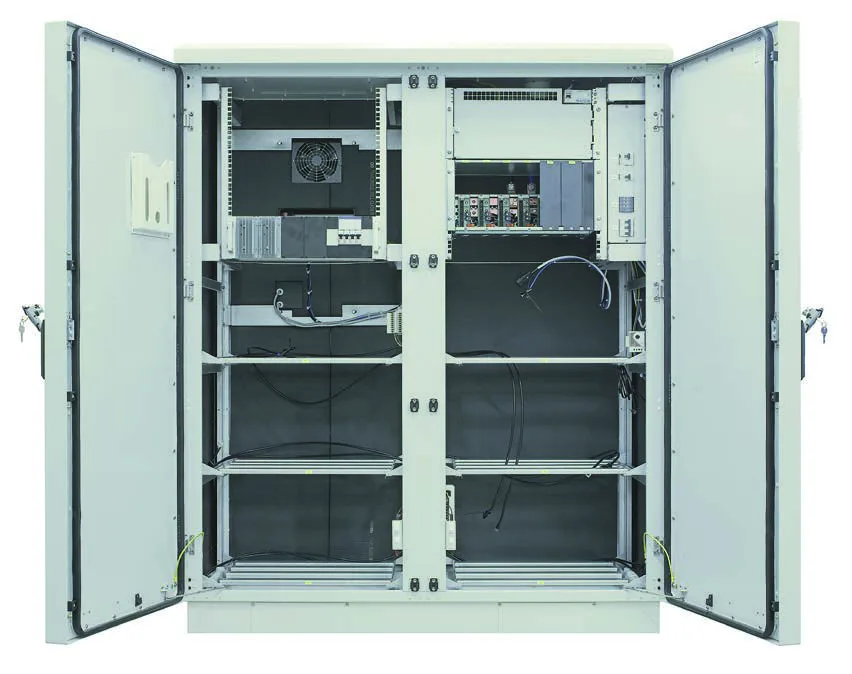
Standards in a marine climate
How aggressive a site is, is described by the corrosivity category to EN ISO 12944: port and coastal environments typically fall into C4 to C5-M — the harshest level, with constant salt exposure. The resistance of material and coating is verified by a salt spray test to ISO 9227, for each project and version. Then there is the degree of protection to EN 60529 (IP 54/55, SWN Inox IP 65) and impact resistance IK10 to EN 62262 for tough port operations.
When it comes to choosing the material, two routes lead to the goal: seawater-resistant, anodised aluminium in the saltwater-resistant SZD version — or AISI 316 stainless steel where splashing water and cleaning agents come together. The materials guide helps you decide.
Which enclosure for which application on the coast?
| Solution | Degree of protection | Material | Typical application |
|---|---|---|---|
| SZD saltwater-resistant | IP 54/55, IK10 | Seawater-resistant anodised aluminium | Quayside, port facilities, coastal infrastructure |
| SWN Inox | IP 65 | AISI 316 stainless steel | Splashing water, deck & washdown areas |
| Outdoor server rack | IP 54/55 | Double-walled aluminium | Port IT, radio & communications |
| SZE2 / SZE3 | IP 54/55 | Sheet steel, powder-coated | Terminal & building services indoors |
Typical project: control systems on the quayside
Starting point: a port operator is modernising the control of loading and lighting equipment along the quayside. The cabinets stand unprotected in salt spray, wind pushes moisture into every joint, at night the equipment cools below the dew point — and during the day heavy machinery operates right next to it.
The solution: saltwater-resistant SZD cabinets in IK10, double-walled against solar load, with a thermostat-controlled heater against condensation and cable entry from below. Where splashing water and cleaning come into play, AISI 316 stainless steel takes over; the port IT sits in the climate-controlled outdoor server cabinet. Material version and salt spray verification to ISO 9227 are documented for each project.
Condensation: the silent enemy in a marine climate
Corrosion rarely starts with the big wave — but with condensation that settles on cold surfaces night after night. Salt in the air makes it conductive and aggressive. Three building blocks help: the rear ventilation of the double wall, which caps temperature peaks, a thermostat-controlled heater that keeps the interior air above the dew point, and sealing levels that keep spray out without making the cabinet airtight. This keeps the equipment dry — even after years on the pier.
The same logic applies to offshore supply — shore installations, base ports, service buildings and deliveries to shipyards: classify the site by corrosivity category, choose the material accordingly, document the evidence for each project. Applications directly on board or on platforms are individually assessed and specified before any commitment is made — with a specification instead of catalogue promises.
Planning checklist: enclosures for marine & offshore supply
These points should be clarified before the tender:
- Corrosivity category: classify the site to EN ISO 12944 (C4/C5-M) — it determines material and verification.
- Choice of material: anodised aluminium (saltwater-resistant SZD version) or AISI 316 — depending on splashing water and cleaning.
- Condensation: plan a heater with thermostat and rear ventilation — in a marine climate, the dew point is the most common cause of damage.
- Mechanics: IK10, concealed hinges, collision protection — port operations are rough.
- Cable entry: from below, with spare capacity — and sealed against salt.
- Evidence: request a salt spray test to ISO 9227 and material documentation for each project.
Why ZPAS
Because every replacement on the coast is expensive: ZPAS designs material, sealing and thermal management for decades — for each project, in any special size, direct from the factory. Reference environments range from a Baltic marina to port logistics.
Frequently asked questions
Which material withstands salt spray in the long term?
Seawater-resistant anodised aluminium (SZD outdoor in the saltwater-resistant version) for most coastal sites; directly at the waterline and where there is spray, AISI 316/316L stainless steel with molybdenum.
What makes the saltwater-resistant SZD version different?
A specially tested alloy and surface treatment, stainless steel fittings and, on request, an additional protective coating — designed and tested for use in coastal and offshore environments.
How is condensation prevented in a marine climate?
With a hygrostat-controlled enclosure heater plus a double-walled design that dampens temperature cycles — both are designed at the factory as one thermal management system.
Does ZPAS also supply shipyard and on-board projects?
Yes — enclosures and desks to drawing in stainless steel or aluminium, with interior fit-out and documentation. Quotation within 2 working days at most.
Which corrosivity category applies at ports and on the coast?
According to EN ISO 12944, typically C4 to C5-M — the highest level, with constant salt exposure. Material and design are engineered for this category and verified for each project.
Is there evidence of salt spray resistance?
Yes — resistance is verified by a salt spray test to ISO 9227, for each project and for the chosen material and coating version.
Where should IT and communications go at the port?
In the outdoor server cabinet: 19-inch level on a double-walled SZD base, climate-controlled and access-controlled — for radio, network and camera equipment right on site.
A project on the coast or in a port?
Site and corrosion zone are all we need — material recommendation and quotation within 2 working days at most.