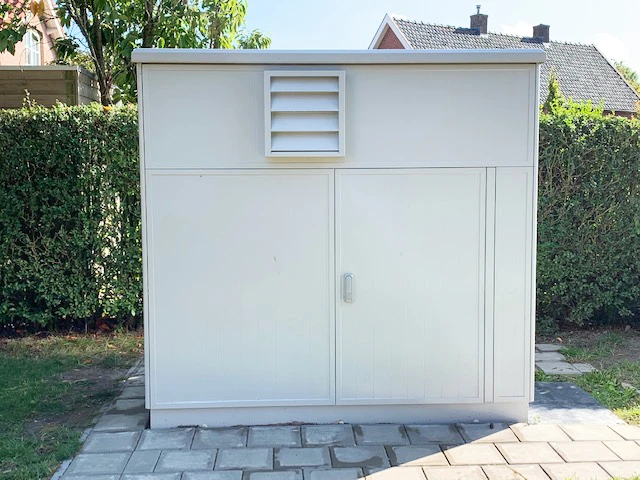
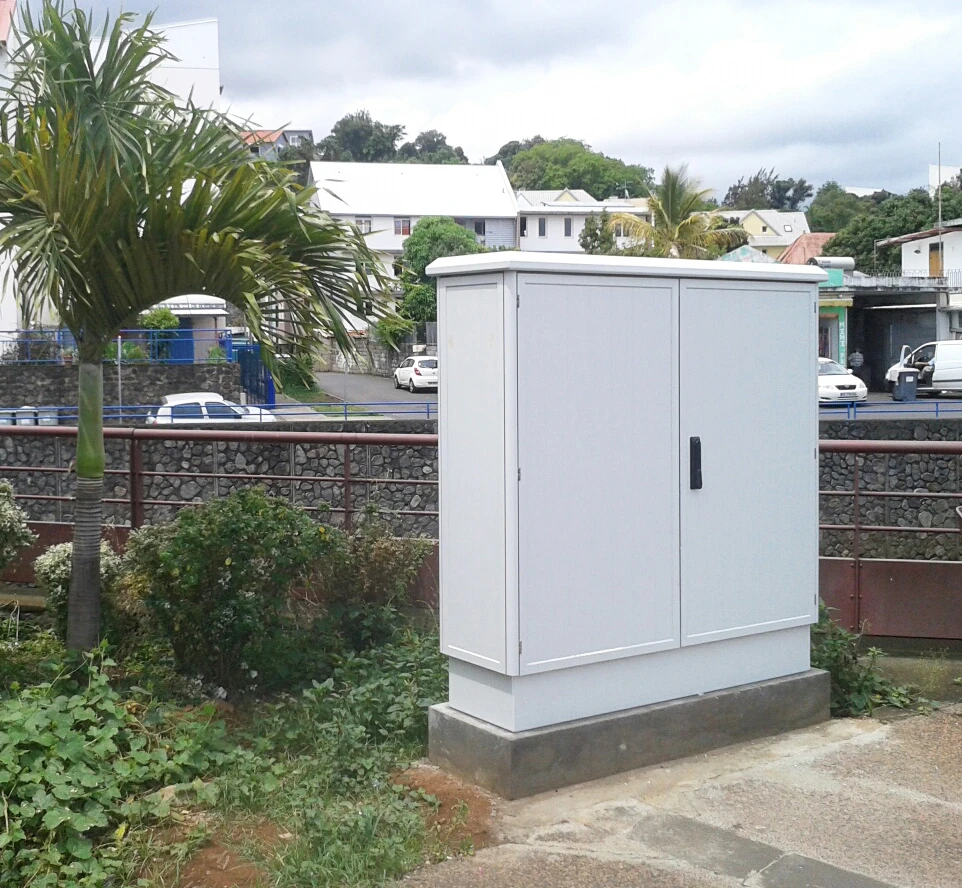
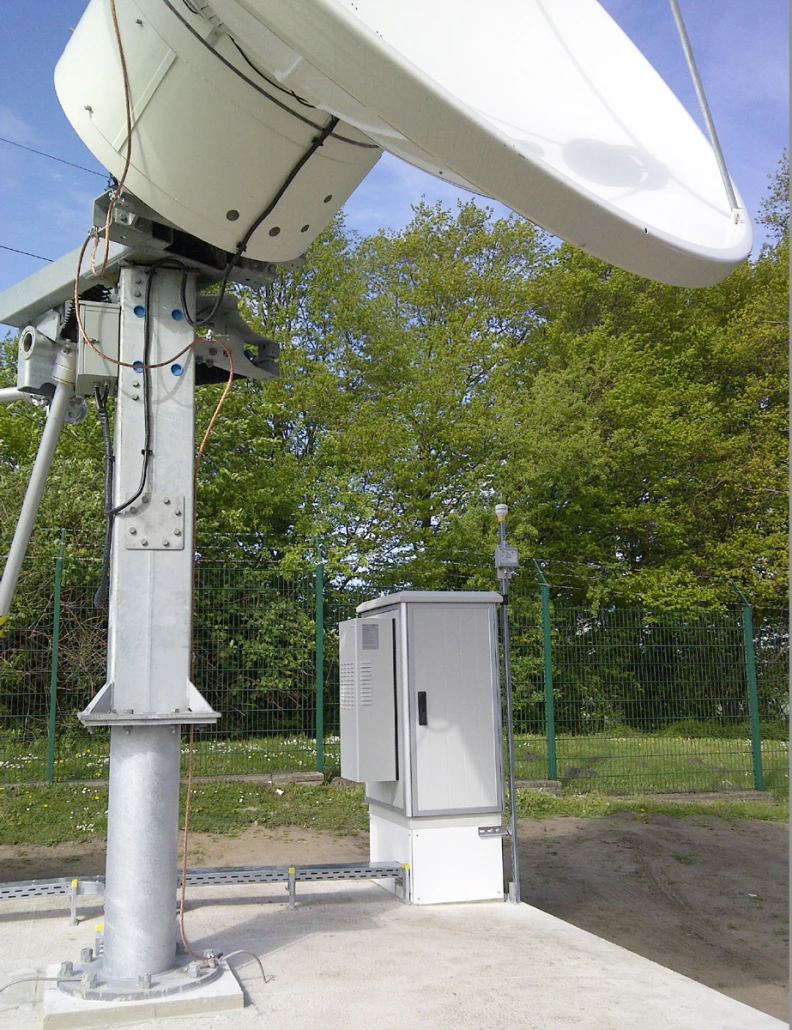
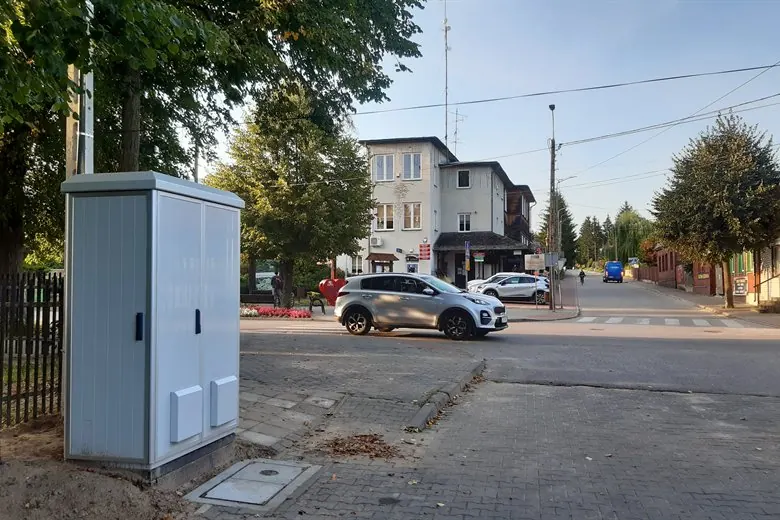
An outdoor enclosure is a weatherproof electrical enclosure for outdoor installation: it protects electronics and network equipment against rain, dust, sun and vandalism (IP54/55, IK10) and operates from −40 to +70 °C. ZPAS manufactures SZD series outdoor enclosures in aluminium — single- or double-walled, climate-controlled, in any special size, direct from the factory.
⚙️ Configure your outdoor cabinet nowIn a few steps — dimensions, degree of protection, climate control & accessories · without obligation →Outdoor electrical enclosure & outdoor enclosure – a short definition
An outdoor enclosure – also called an outdoor cabinet, outdoor electrical enclosure, electrical enclosure for outdoor use, weatherproof electrical enclosure, outdoor control cabinet, outdoor housing, street cabinet or open-air cabinet – is an all-weather enclosure for permanent use outdoors. It reliably protects built-in devices, controls and network components against rain, wind, UV radiation, snow and temperature fluctuations as well as against unauthorised access. The term outdoor housing is synonymous — what matters is suitability for permanent outdoor installation without additional weather protection.
ZPAS aluminium outdoor enclosures achieve degree of protection IP54 (IP55 on request) to EN 60529 and a mechanical impact resistance of IK10 to EN 62262. Customers with special requirements receive individual custom solutions – at ZPAS, deviations from the standard are not the exception but everyday business. For use in halls and plant rooms, we recommend a ZPAS electrical enclosure for indoor use instead.
Outdoor enclosures in sheet steel are optionally available. This is usually for budget reasons, when the enclosures are very well protected or only have a short operating life. Single-walled outdoor enclosures are optionally available as well.
Aluminium outdoor cabinets: design and advantages
The aluminium series (Alum for short) is the most frequently manufactured segment of ZPAS outdoor enclosures. Anodised aluminium profiles form the load-bearing frame of the outdoor cabinets – lighter than steel, fully corrosion-resistant and dimensionally stable at temperatures from −40 to +70 °C.
Degree of protection IP 54/55
IP54 as standard, every size also available as IP55 on request – dust-protected and protected against water jets from all directions.
Impact resistance IK10
Highest class – withstands mechanical impacts of 20 joules.
Anodised aluminium
“Alum” material – weight-optimised, maintenance-free and UV-resistant.
Flexible dimensions
Standard widths 409–1,654 mm, depths 409–1,009 mm, height freely selectable. Special sizes in every direction – even over 4 m wide.
Surface protection
RAL 7035 as standard, special colours from the RAL chart available.
EMC versions
Chromated surface for electromagnetic shielding on request.
Double-walled design
Double-walled design as standard – the air layer between the walls insulates against solar radiation and temperature fluctuations and protects the equipment inside. Single-walled optional.
Bayable
Several cabinets can be bayed side by side — scalable up to a complete cabinet row.
Double-walled aluminium profiles: the operating principle
The key feature of high-quality outdoor cabinets is the double-walled aluminium construction. Unlike a single-walled enclosure, the outer skin consists of two aluminium shells with an air gap in between. This construction of double-walled aluminium profiles thermally decouples the built-in equipment from the outer wall and is the most effective passive protection against summer heat build-up — before active climate control even has to start.
Sun protection through rear ventilation
In direct sunlight, the outer shell heats up to as much as +70 °C. The ventilated air gap removes this heat by convection before it reaches the inner wall — the internal temperature remains noticeably lower than in a single-walled cabinet.
Frost & condensation protection
In winter, the air layer insulates in the opposite direction: it reduces heat loss to the outside, decouples the warm inner wall from the cold shell and thus reduces condensation and the energy demand of the heater.
Less climate control effort
Because the double wall buffers the thermal load passively, the heat exchanger, air conditioner or AHP runs less often and for shorter periods. This saves energy over the entire service life and extends the life of the components.
At ZPAS, double-walled is the standard for permanent outdoor use. A single-walled version is optionally available — for example for shaded locations, short operating periods or a tight budget. Our single-walled / double-walled comparison shows when each variant pays off.
Baying system: start with one cabinet, extend as needed
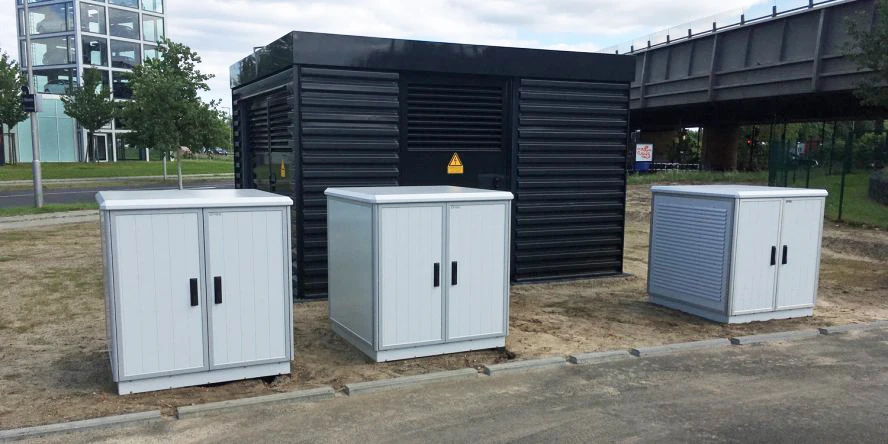
ZPAS outdoor cabinets are bayable. This means a project can start with a single outdoor enclosure. If the space requirement grows — due to more equipment, additional power feeds or new functional units — a second, third or further cabinets are simply bayed alongside. No replacement, no new build. The cabinets are joined mechanically and visually into a uniform cabinet row, with a common foundation or plinth frame. Ideal for power distribution, transformer substations, 5G infrastructure or any installation that grows step by step.
Thermal management in outdoor enclosures
An outdoor cabinet must not only seal – it must also control the temperature. Modern devices generate power loss that has to be dissipated without compromising the degree of protection. Depending on the application, ZPAS integrates various thermal management systems directly into the outdoor enclosure:
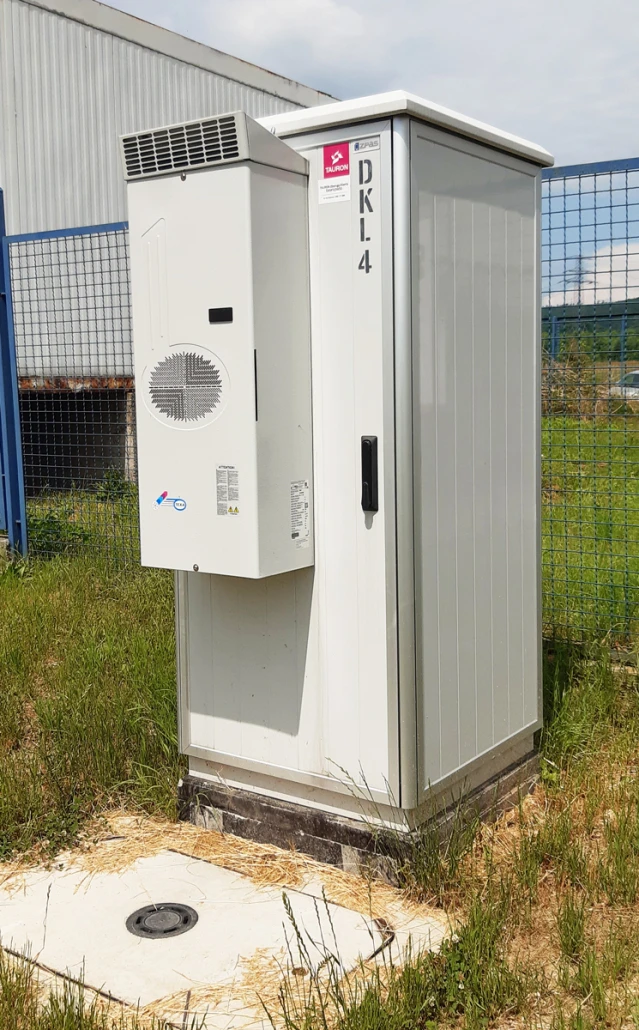
The AHP series (Air Heat Pump) is a patented ZPAS development: heat pump technology controls the temperature of the outdoor enclosure: one unit cools and heats, and the output is modulated instead of being switched on and off – relevant for 5G base stations, charging infrastructure and smart grid applications, where every kilowatt hour saved counts.
📘 In the catalogue: Ventilation systems from p. 16 · Climate control from p. 20 (PDF, 64 pages)
Design in detail: doors, seals, roof and mounting
Weather resistance does not come from the wall alone but from the details — where doors close, cables enter and rain has to drain away. These are exactly the points that decide whether an outdoor electrical enclosure is still sealed after years in service. ZPAS solves them by design:
Doors & locking systems
Single or double doors with all-round reinforcement, swing handle lock and profile half-cylinder. On request, multi-point locking, comfort handle or electronic lock for controlled access.
Sealing concept
All-round foamed-in or inserted seal on door and roof. The sealing plane maintains degree of protection IP54/55 permanently — even after many opening and maintenance cycles.
Rain roof
A sloping, overhanging roof drains precipitation reliably — no standing water, no ingress at the top edge of the door. Optionally with an additional sun shield against radiant heat.
Plinth & foundation
Plinth frame with cable entry from below, lifting eyes for transport, prepared for concrete, strip or screw foundations — can be closed off against dust and rodents.
Mounting options
Floor, wall or pole mounting. Interior fit-out with mounting plate, 19″ frame or DIN top-hat rails as required — precisely matched to the built-in equipment.
Corrosion protection
Anodised aluminium is naturally corrosion-resistant. For coastal and offshore locations (up to corrosivity category C5-M), the saltwater-resistant marine version of the SZD is available. More on corrosion protection.
Passive cooling
The aluminium walls and doors release heat directly to the surroundings. In the double-walled shell, the chimney effect — thermal buoyancy — creates natural air circulation that removes the solar load, without any electricity.
Active climate control
If passive dissipation is not sufficient, filter fans, air/air heat exchangers or a cooling unit are added — depending on power loss and location. More on outdoor climate control.
Product series: SZD outdoor cabinets and custom builds
The SZD series is the standard range of outdoor enclosures in aluminium. Degree of protection IP54 as standard (IP55 on request), IK10 throughout. All dimensions can be configured to suit the project.
Outdoor enclosures: typical applications and industries
5G infrastructure and telecommunications: mobile network operators install thousands of base stations outdoors — each one needs an outdoor enclosure that withstands vandalism (IK10), rain (IP54/55) and temperature fluctuations from −40 to +70 °C. The ZPAS SZD is bayable: a site can start with one cabinet and be extended as needed, without replanning.
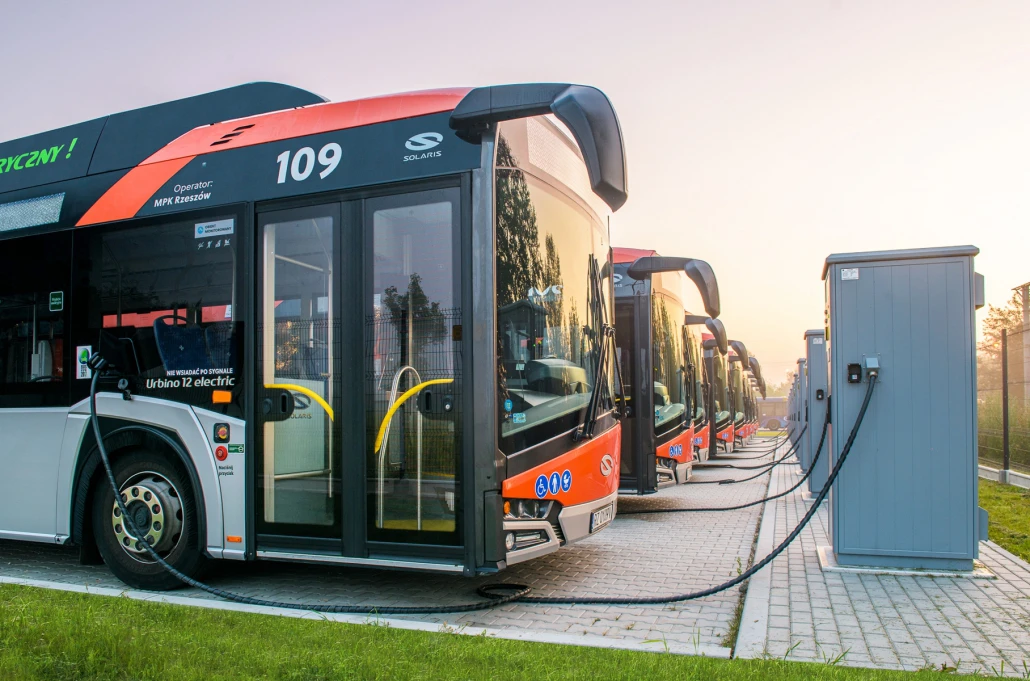
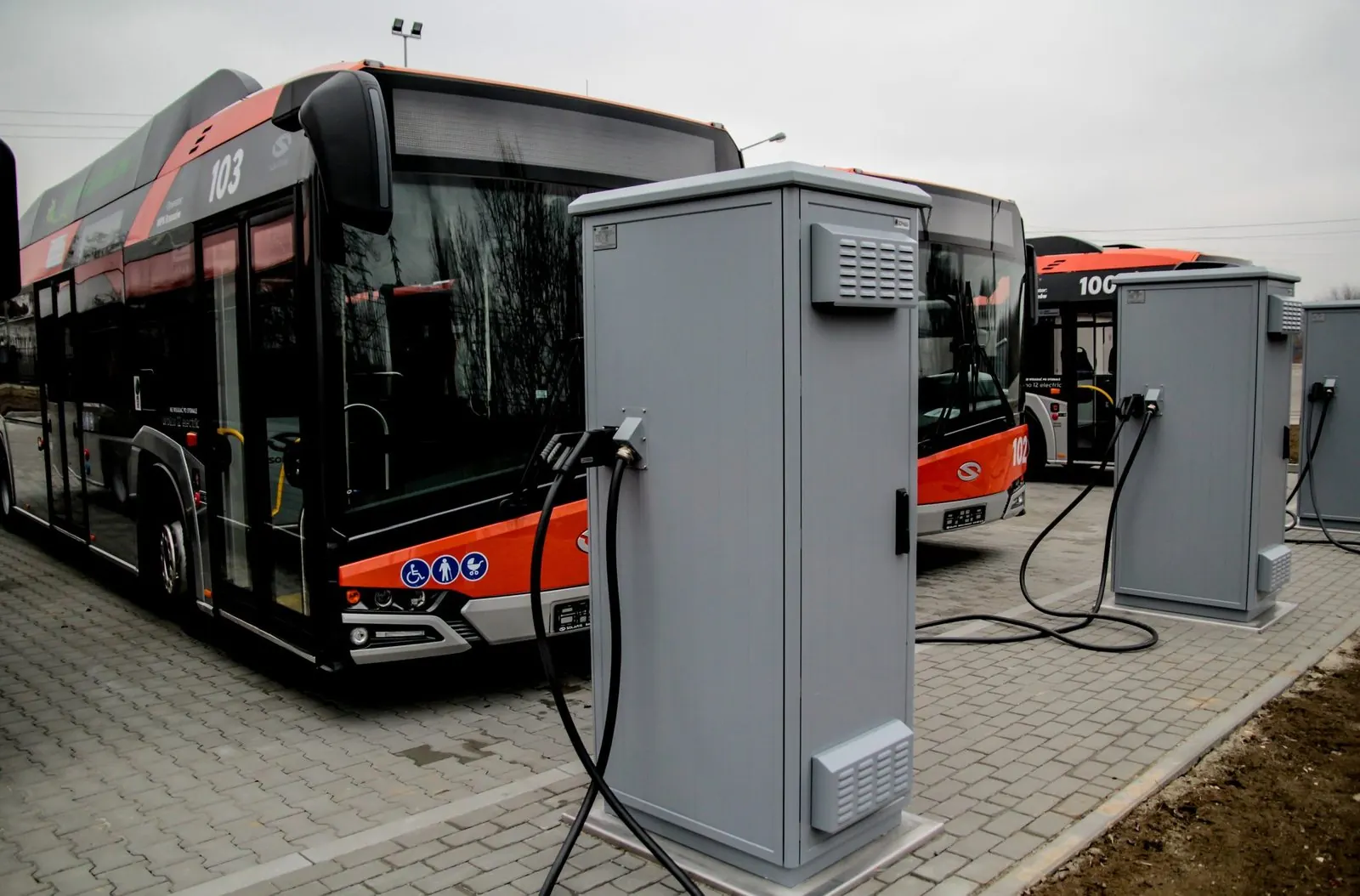
Charging infrastructure and BESS — battery energy storage systems: DC charging station control units and grid-connected battery storage generate high power loss in a compact enclosure — active thermal management is a must. The ZPAS SZD integrates air/air heat exchangers or the patented AHP Air Heat Pump directly; coefficient of performance (COP) up to 5, power consumption of around 1,200 kWh per year.
Photovoltaics, wind power and smart grid: inverters, SCADA systems and medium-voltage installations in open fields need low-maintenance enclosures for 20+ years. At coastal sites or on offshore platforms, saltwater resistance is decisive — the marine version of the ZPAS SZD is specifically designed and tested for these environments.
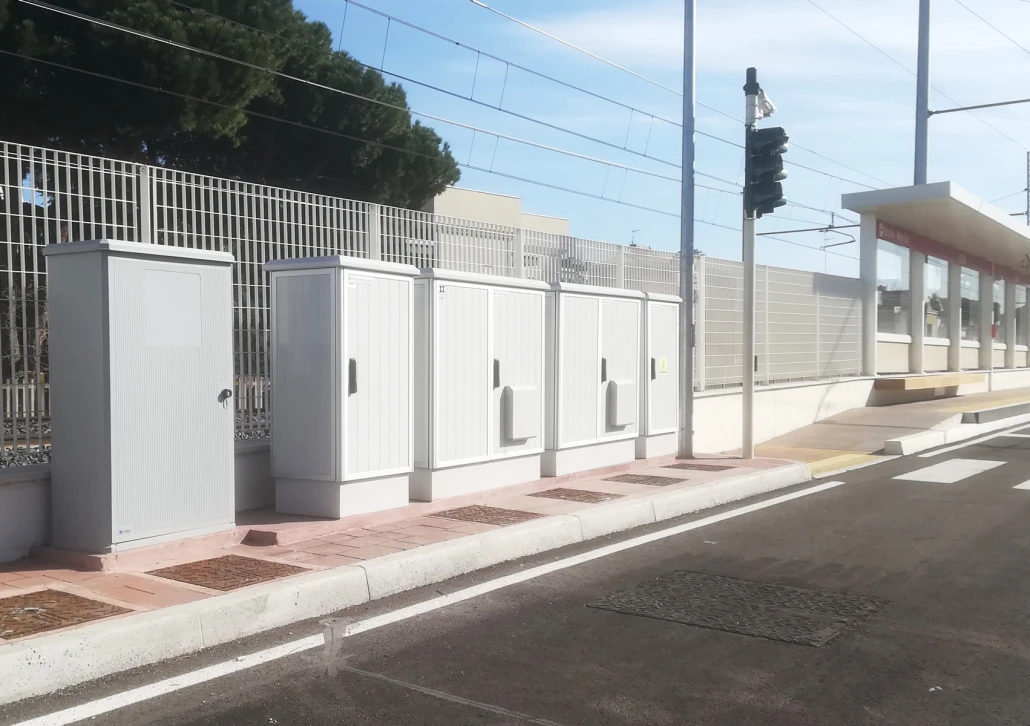
Rail, municipal utilities, industry and marine: from points control to pumping stations, port platforms, refineries and tunnel equipment: wherever electronics operate permanently outdoors with no building to protect them, an outdoor enclosure with IK10, IP54/55, CE certification and integrated thermal management is the right solution.
Electrical cabinet for outdoor use: what matters for outdoor installation
For outdoor installation, details that play no role inside a building become decisive: a plinth or foundation frame for a secure stand on concrete or soil, cable entry from below to prevent standing water, UV-resistant seals and surfaces, and a rain roof with clean water drainage. Then there is the climate inside the cabinet itself: during the day the sun heats up the outdoor electrical enclosure, at night cooling causes condensation — so climate control or heating belongs in the planning from the outset (see thermal management).
📘 In the catalogue: Industry versions (energy, fibre optics, UPS, access systems) from p. 40 (PDF)
IP54, IK10, IEC 62208: standards and degrees of protection for outdoor enclosures
All ZPAS outdoor enclosures and outdoor cabinets are manufactured and tested to the applicable standards:
- IP54 as standard, IP55 on request, to EN 60529 – dust-protected, protected against splashing water or water jets
- IK10 to EN 62262 – highest impact resistance class, 20 joules
- IEC 62208 – empty enclosures for low-voltage switchgear and controlgear assemblies
- EMC versions with chromated aluminium surface for electromagnetic shielding
- CE declarations of conformity are provided with every delivery
IP55 outdoor enclosure: when the higher degree of protection makes sense
As standard, ZPAS supplies SZD outdoor enclosures in IP54 — but every size is also available on request as an IP55 outdoor enclosure: same dimensions, same accessories, reinforced sealing against water jets from all directions to EN 60529. An IP55 outdoor enclosure is the right choice wherever a directed water jet can hit it: cleaning with a hose, splash zones along roads and at wash bays, exposed coastal sites with sea spray. For normal weathering — rain, dust, snow — a well-designed IP54 enclosure with a rain roof and clean water drainage is the more economical choice; the IP54 or IP55 guide explains the difference in detail. In the outdoor cabinet configurator, you can select the degree of protection directly.
Tested: climate, shielding and acoustics
The SZD cabinets were tested at technical universities — the test diagrams are in the outdoor cabinets catalogue from p. 25 (PDF):
- Climatic suitability: SZD cabinets fitted with equipment from various manufacturers (Siemens, Ericsson, DGT, Ascom) underwent a cold test lasting several hours at −33 °C and a heat test at +40 °C in the quality laboratory for telecommunication systems at the Szczecin University of Technology. The temperature curves in the equipment and battery compartments are documented.
- Shielding effectiveness: Wrocław University of Technology measured the shielding from 100 kHz to 1,000 MHz — between 30 and 1,000 MHz up to 55 dB (horizontal) and 65 dB (vertical polarisation).
- Acoustics: sound level of fans and heaters, averaged over 11 measuring points in the cabinet.
Technical data at a glance
The most important specifications of ZPAS SZD series outdoor enclosures and outdoor electrical enclosures at a glance. All dimensions and equipment can be configured to suit the project — the table shows the standard and the common options.
| Parameter | Specification |
|---|---|
| Degree of protection (IP) | IP54 as standard, IP55 on request — tested to EN 60529 |
| Impact resistance (IK) | IK10 (20 joules) to EN 62262 — highest class |
| Enclosure material | Anodised aluminium (Alum); sheet steel or stainless steel optional |
| Wall construction | Double-walled as standard, single-walled optional |
| Operating temperature | −40 °C to +70 °C |
| Dimensions (W × H × D) | Width 409–1,654 mm and depth 409–1,009 mm as standard, height freely selectable; special sizes even over 4 m wide and well over 2 m high |
| Colour / surface | RAL 7035 as standard, special colours from the RAL chart |
| Doors & locking | Single or double door, swing handle with profile half-cylinder; multi-point optional |
| Roof | Sloping rain roof, overhanging — no standing water |
| Installation & mounting | On a plinth, stainless steel foundation frame or concrete foundation; small cabinets with wall or pole bracket |
| Thermal management | Ventilation, air/air and air/water heat exchangers, cooling unit, AHP heat pump, PTC heater |
| EMC shielding | Chromated aluminium surface on request |
| Standards & conformity | EN 60529, EN 62262, IEC 62208; CE declaration of conformity with every delivery |
| Custom build | Dimensions, material, cut-outs and equipment to drawing or specification |
Standard dimensions of the SZD outdoor electrical cabinets
SZD cabinets are built modularly from aluminium profiles — so any size can be made in all three directions. The table shows the standard widths from the catalogue; you choose the height freely. Special sizes are possible in every direction – even widths over 4 m (with several doors) and heights well over 2 m.
| External width W | Internal width W1 | Door |
|---|---|---|
| 409 mm | 283 mm | single door |
| 509 mm | 383 mm | single door |
| 609 mm | 483 mm | single door |
| 709 mm | 583 mm | single door |
| 809 mm | 683 mm | single door |
| 1,009 mm | 883 mm | single door |
| 1,154 mm | 1,028 mm | double door |
| 1,254 mm | 1,128 mm | double door |
| 1,354 mm | 1,228 mm | double door |
| 1,453 mm | 1,328 mm | double door |
| 1,554 mm | 1,428 mm | double door |
| 1,654 mm | 1,528 mm | double door |
- Standard depths D: 409 · 509 · 609 · 709 · 809 · 1,009 mm (internal 283–883 mm)
- Height: freely selectable, usable height = height − 120 mm; plinth height as required
- Special sizes: internal width = W − 126 mm, internal depth = D − 126 mm; cabinets with more than two doors on request
📘 In the catalogue: Dimensions of SZD cabinets from p. 14 (PDF) · Choose dimensions in the outdoor configurator →
More by industry: charging infrastructure & e-mobility and photovoltaics & wind power show typical open-field projects — with references to standards and a checklist.
Technology in detail: how an SZD is built
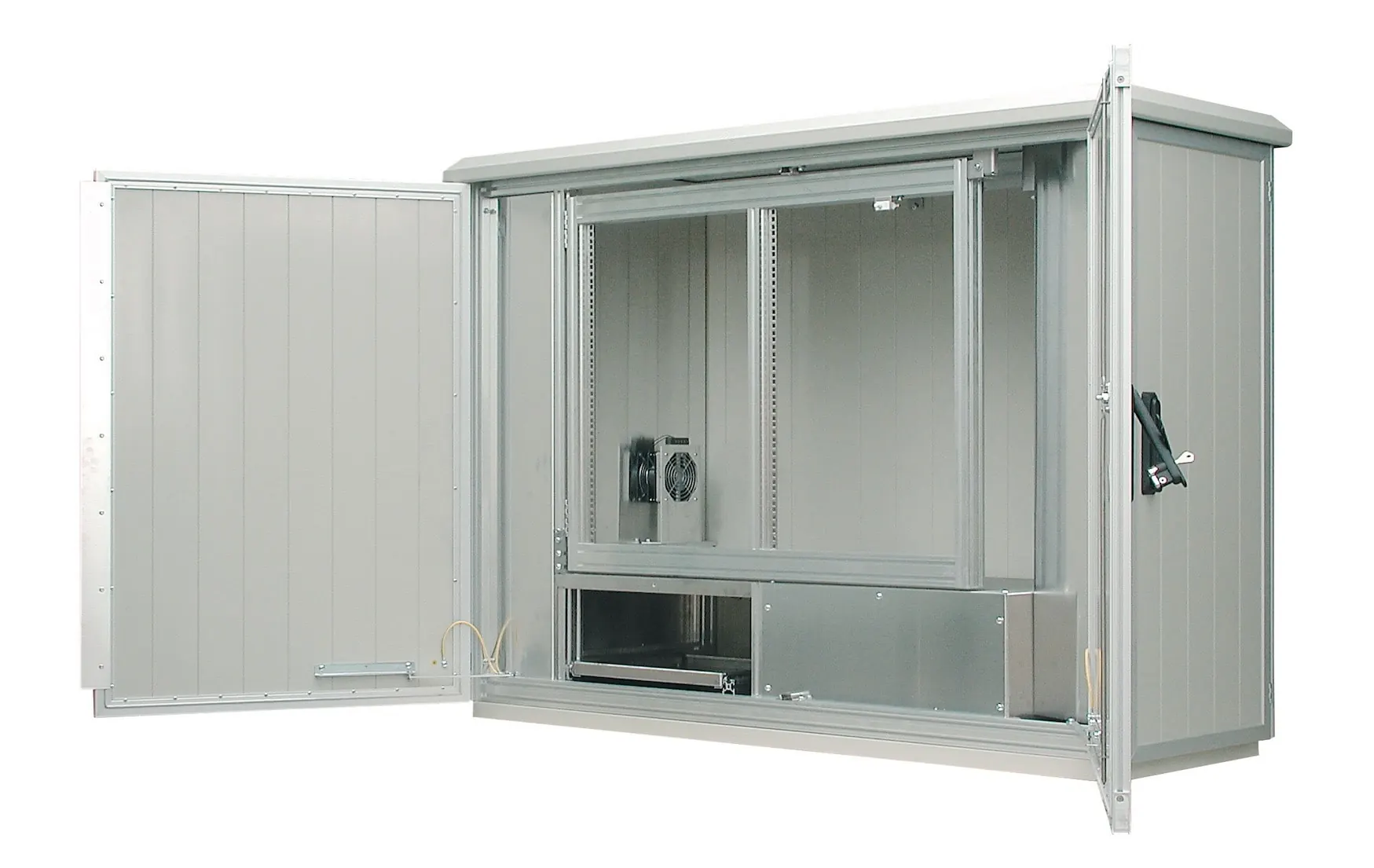
The supporting structure is a frame of anodised aluminium profiles with internal channels — swing frames and any supporting structures can be mounted on it. The door and side panels consist of interlocking aluminium profiles that form a double wall with an air layer; the roof consists of two 1.5 mm sheet metal skins whose intermediate space drains off condensation. The plinth height can be chosen between 40 and 300 mm; the outer roof skin and plinth are alternatively available in stainless steel or galvanised sheet steel.
Locking is by 2-point espagnolette locks; alternative lock cylinders (e.g. ABLOY, EMKA) are available on request, as are door openings for connecting external generators. For EMC-critical sites there is the EMC version: chromated profiles and conductive seals ensure electrical conductivity between roof, plinth, walls and door.
Inside, four autonomous compartments can be separated — battery (at the bottom, with its own cooling), system equipment (19″/21″ level or swing frame), MDF (copper connection level) and electrical (fuses, generator connection and, on request, a meter window for reading without opening the door). Multi-door cabinets and versions for fibre-optic systems, power engineering or externally mounted UPS are also standard custom builds.
And if space becomes tight later on: ZPAS has developed three ways to extend existing cabinets in the field — additional side segments, an additional shell over the existing enclosure or conversion to a larger enclosure. Besides the profile construction, the SZD family is also available in aluminium sheet: single-walled (2 mm) or double-walled (2 mm outside, 1–1.5 mm inside). The outdoor climate control page shows the heat dissipation options in detail, and the outdoor cabinet accessories page the complete accessory range — from swing frames to concrete foundations.
📘 In the catalogue: Construction & aluminium profiles from p. 10 · Accessories (swing frames, plinths) from p. 29 (PDF)
Frequently asked questions — outdoor enclosures
What is the difference between an outdoor enclosure and a standard electrical enclosure?
A standard electrical enclosure is designed for indoor areas (halls, plant rooms) and typically achieves IP54 or IP55. An outdoor enclosure is developed for permanent outdoor use without a roof or building protection: made of anodised aluminium, IP54 as standard (IP55 on request), mechanical impact resistance IK10, operating temperature −40 to +70 °C. → More details in the FAQ
What temperatures can ZPAS aluminium outdoor enclosures withstand?
ZPAS outdoor enclosures (Alum SZD series) are designed for an operating temperature range of −40 to +70 °C — from arctic conditions to desert heat. For frost protection, an integrable PTC heater is available; for heat dissipation, air/air heat exchangers, an air conditioner or the patented AHP (Air Heat Pump).
Which applications are aluminium outdoor enclosures suitable for?
Wherever equipment is operated permanently outdoors: 5G base stations, fibre-optic distribution, PV inverters, wind turbine controls, charging station control units, BESS battery storage, transformer substations, pumping stations and rail infrastructure. The marine version of the SZD is specifically designed for coastal and offshore use.
Are ZPAS outdoor cabinets single-walled or double-walled?
As standard, ZPAS outdoor cabinets are built from double-walled aluminium profiles. Between the outer and inner shell there is a ventilated air gap that removes the heat of the sun-exposed outer wall by convection before it reaches the equipment – passive protection against sun and frost that reduces the climate control effort. A single-walled version is optionally available, for example for shaded locations, short operating periods or a tight budget.
Are the outdoor enclosures also available in IP55?
Yes — every SZD size is available on request as an IP55 outdoor enclosure, with reinforced sealing against water jets from all directions (EN 60529). The standard is IP54; the IP54 or IP55 guide explains when the step up to IP55 is worthwhile.
Is the outdoor electrical cabinet available with a plinth?
Yes. As standard, the SZD stands on a plinth whose height you specify. For anchoring there is a stainless steel foundation frame for setting in concrete or burying in the ground, a 600 mm high aluminium plinth with height-adjustable stainless steel foot and concrete foundation frames with templates for the cable conduits and cable entries on every side.
Can the outdoor electrical cabinet be locked?
Yes. The doors are closed with espagnolette locks with 2-point locking. On request we fit alternative lock cylinders, for example ABLOY or EMKA. On top of that comes IK10 impact resistance against mechanical force.
Can the outdoor cabinet be mounted on a wall or pole?
Small cabinets yes — with wall or pole brackets. Larger outdoor electrical cabinets stand on a plinth, foundation frame or concrete foundation.
What does an outdoor electrical cabinet cost and how quickly is it delivered?
The price depends on dimensions, wall design, thermal management, interior fit-out and quantity. You receive a quotation within 2 working days at most. Delivery takes 8–10 weeks for a new drawing and approx. 6 weeks for repeat orders. The eight price factors in detail: What does an outdoor enclosure cost?
Buying outdoor enclosures: direct from the manufacturer
You can obtain ZPAS outdoor enclosures and outdoor electrical enclosures via short supply chains — depending on project size, direct from the factory or via selected distribution partners. Send us an enquiry or put together your cabinet in the online configurator; we will get back to you with a binding quotation.
Direct from the factory
Advice, design and manufacturing from a single source — short supply chains, direct project support from the manufacturer.
Quotation within 2 working days at most
For every enquiry — via form, configurator or phone — you receive a quotation within 2 working days at most.
Predictable delivery times
Customised outdoor enclosures: 8–10 weeks for a new design, approx. 6 weeks for repeat orders.
Top European quality
Developed and manufactured in our own European factory — anodised aluminium profiles, powder coating and EN-tested seals that withstand wind and weather for years.