A data centre is the structural and technical environment in which IT systems are operated securely, cooled and with an uninterrupted power supply: server racks, airflow management, air conditioning, power supply, fire protection and monitoring. ZPAS manufactures this infrastructure — from a single 19″ rack and the contained rack row to the turnkey container data centre.
Planning a data centre — the building blocks at a glance
This page is the starting point for all data centre topics. From here, the paths lead to the respective product and solution pages:
19″ server racks & cabinets →
Z-SERVER, SZB IT, DSR IT and open racks — heights, widths, depths and load capacities at a glance.
Databox: containment →
Cold aisle/hot aisle containment as a product: sliding doors, roof modules, building blocks and catalogue numbers.
Air conditioning & cooling →
Filter fans, cooling units, air/water heat exchangers and precision air conditioning for the server room.
Micro data centre →
One or a few racks as a self-contained unit — for edge sites, branches and side rooms without a dedicated server room.
Container data centre →
Turnkey edge data centre in a container — racks, cooling, UPS, fire protection, delivered ready for operation.
Z-SERVER heavy-duty rack →
42/45/47 U, 1,600 kg load capacity on levelling feet (2,000 kg without), 86% door perforation — the rack for high densities.
Calculate cooling capacity →
Enter heat dissipation, ambient temperature and target value — and get a suitable cooling solution as a suggestion.
From server rack to turnkey data centre
ZPAS has been a manufacturer of rack infrastructure for telecommunications, power supply and IT for more than 50 years. Today, the range extends from the single server rack and modular server room systems with precise air conditioning to the turnkey container data centre – including cooling, power supply, fire protection and monitoring, all from a single source and direct from the manufacturer. Whether for your own data centre or colocation infrastructure for several tenants — ZPAS supplies the right rack solution: the DSR IT colocation server rack with separately lockable compartments or open 19″ racks SRD/SRX for the secured server room.
Scope of supply depending on the project: concept and planning, execution, certifications, installation, commissioning and maintenance contract. And where IT equipment has to be located outside the building — at network nodes and edge sites — ZPAS supplies the weatherproof, air-conditioned outdoor server cabinet. How this becomes a complete container data centre or edge data centre is shown on the solutions page.
Cold aisle & hot aisle containment — briefly explained
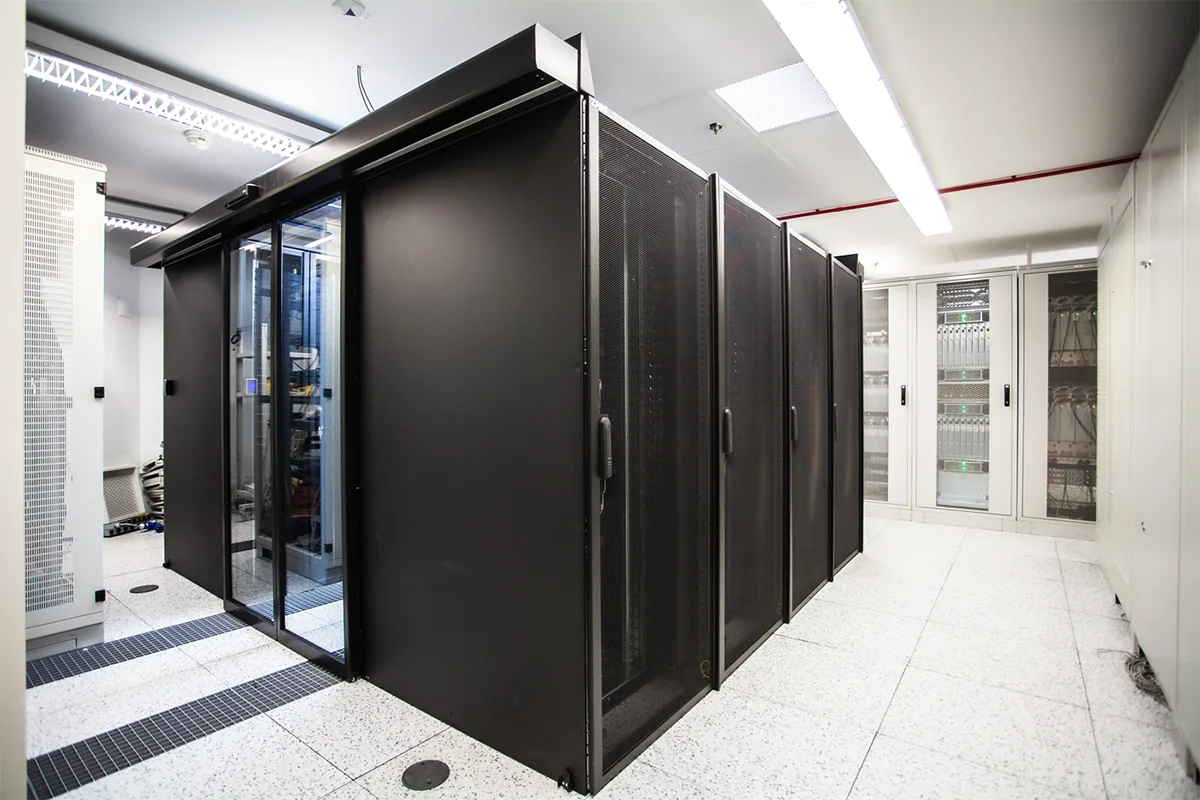
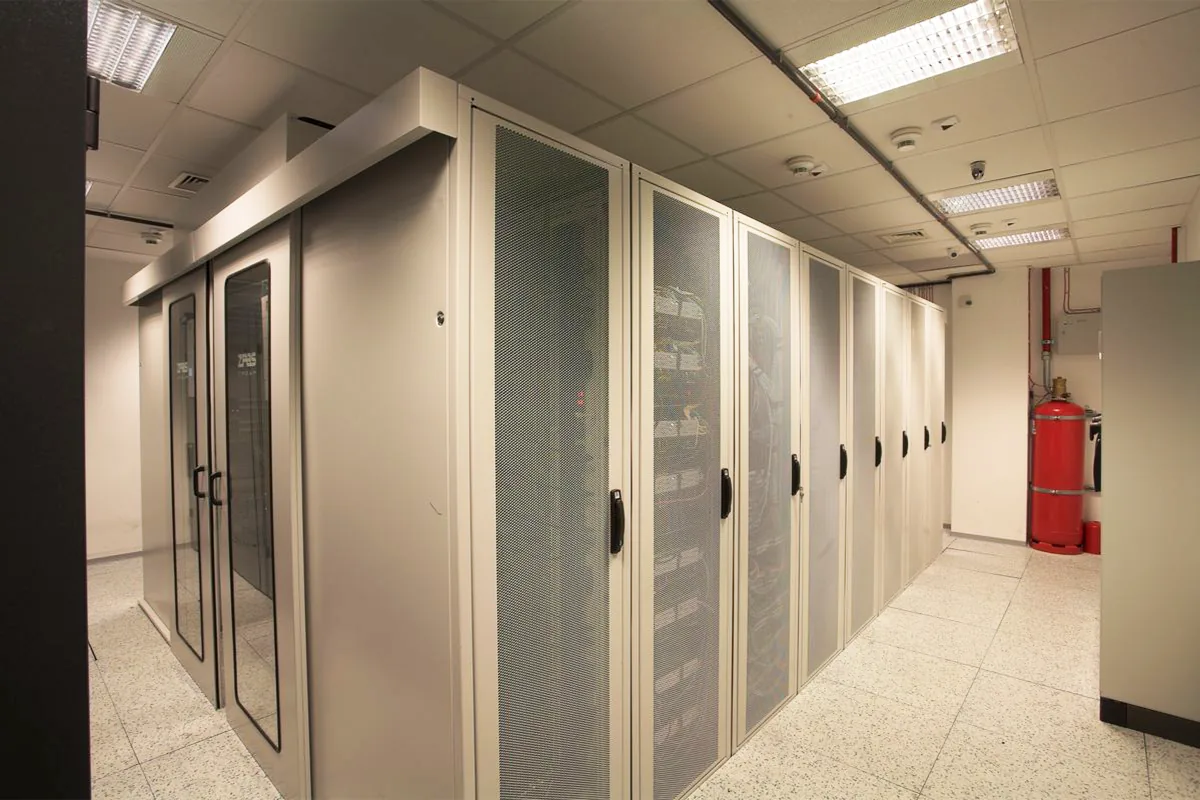
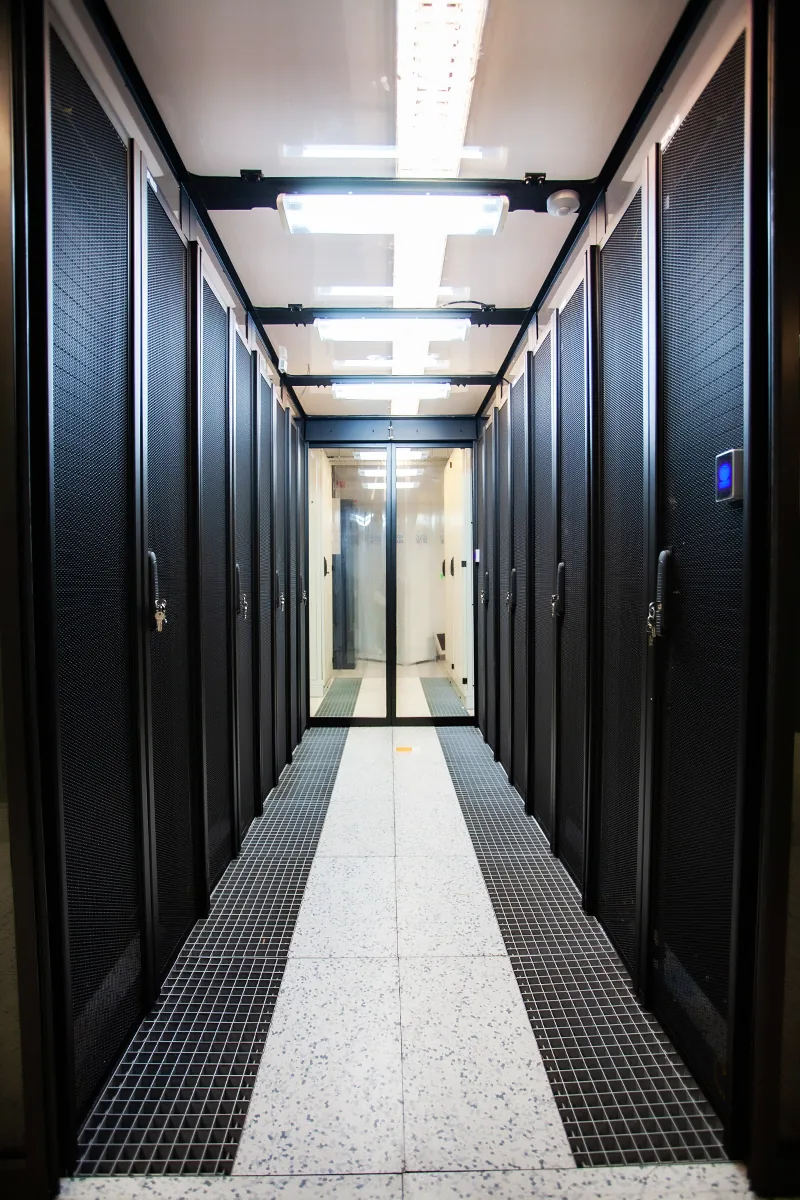
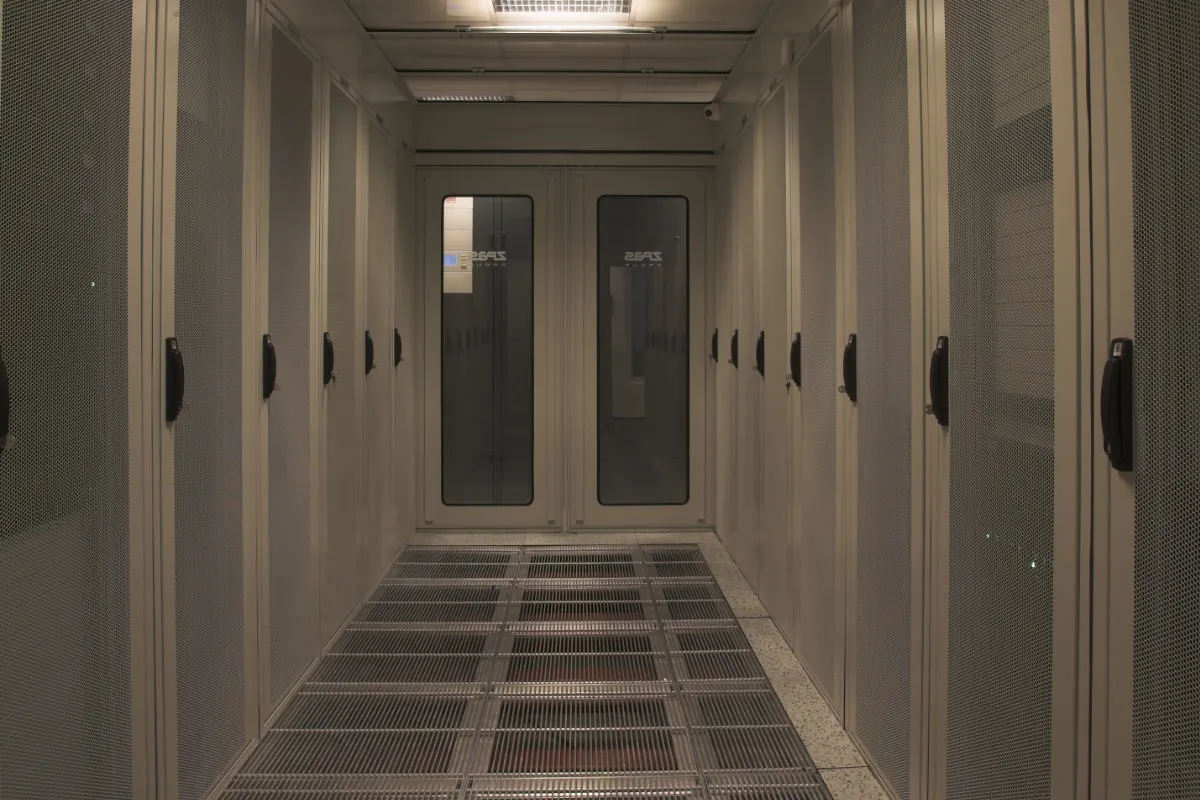
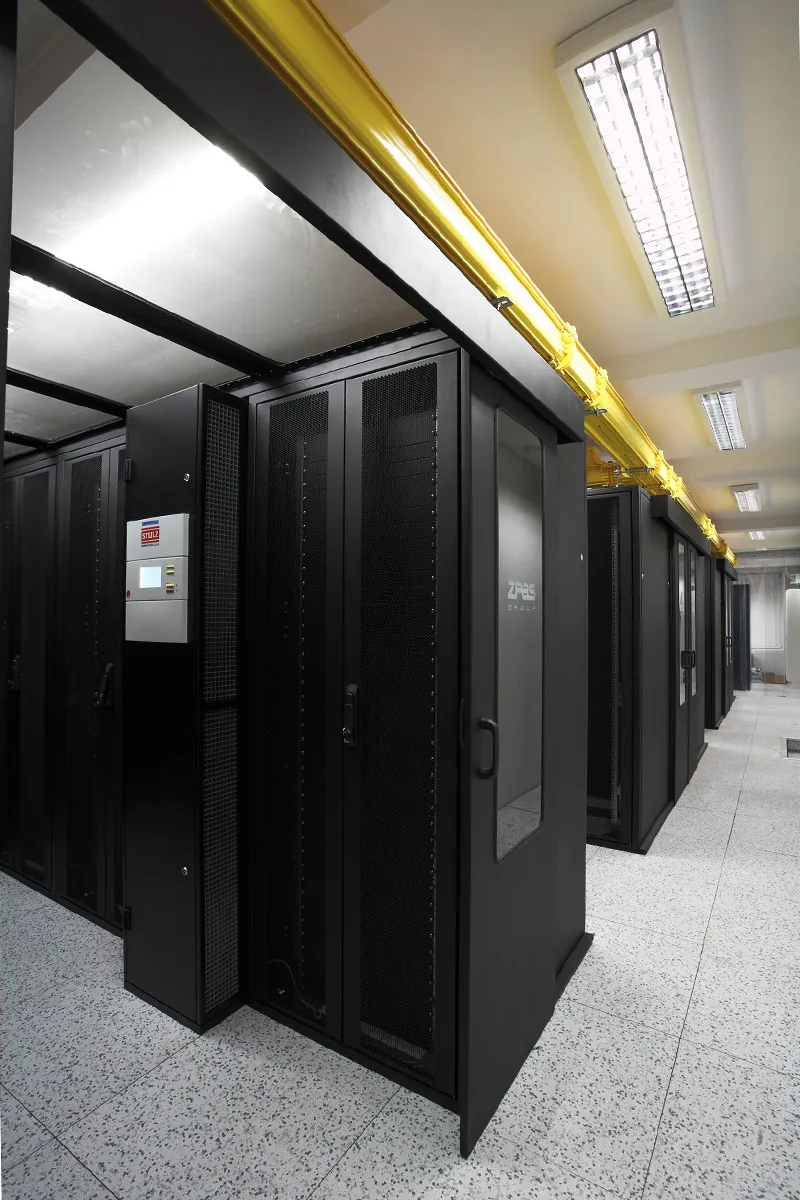
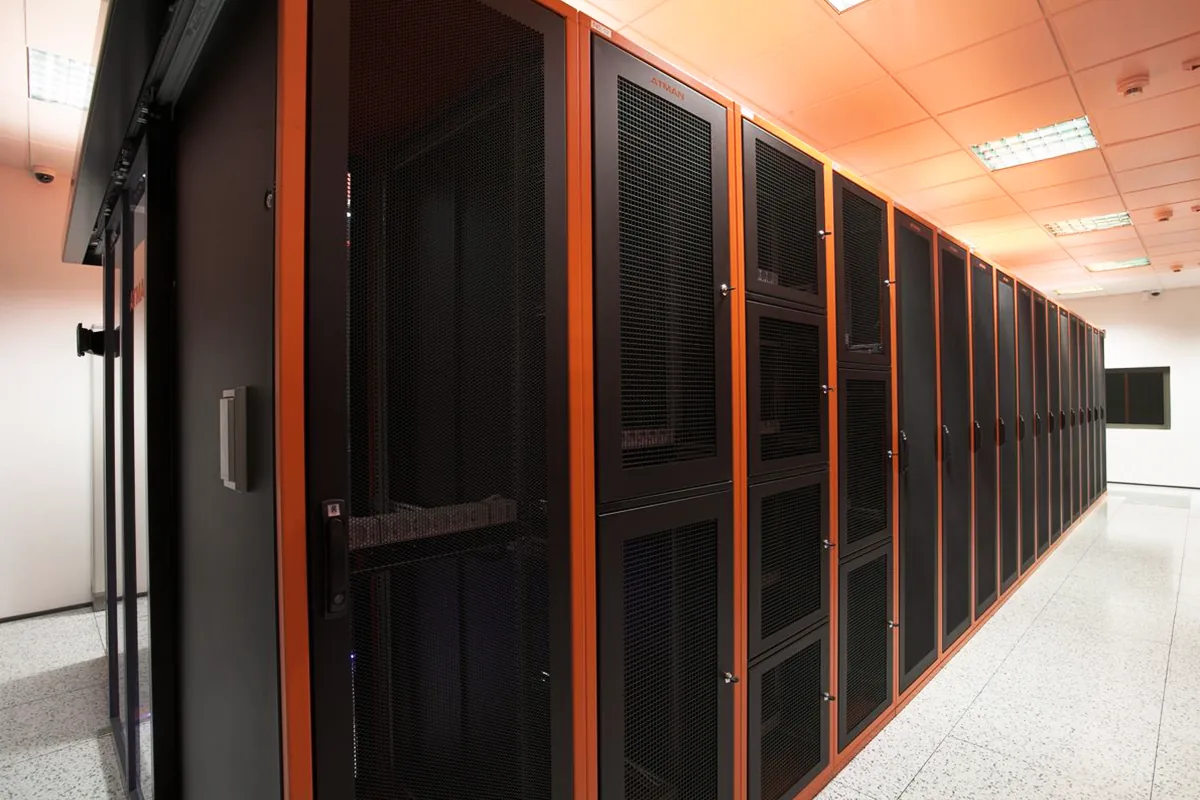
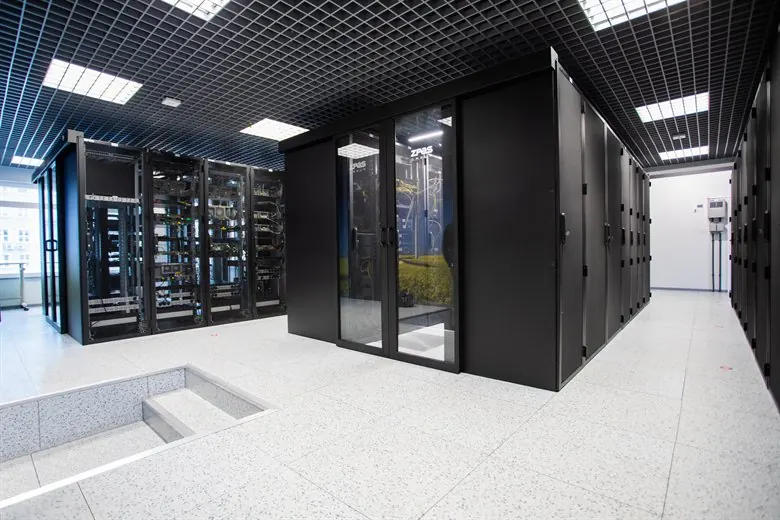
Efficient cooling of a server room depends on separating cold supply air from warm exhaust air. Without containment, the two airflows mix across the rows, and the air conditioning has to supply colder air in greater volumes. Cold aisle or hot aisle containment eliminates this mixing and reduces the cooling energy requirement by up to 40%. At ZPAS, containment is available as the Databox: server racks with sliding doors and a common roof structure, which can be integrated into existing server rooms without conversion work and extended with further rack rows. Fire protection is provided by a NOVEC 1230 gas extinguishing system in 19″ format (1 U), which can be integrated into any server rack.
Cold aisle
The aisle in front of the server fronts, into which the air conditioning blows cold supply air (typically 20–24 °C). The servers draw in this air.
Hot aisle
The aisle behind the racks, into which the servers expel their heated exhaust air. From here, the heat is removed.
Containment
Roof, sliding doors and partition walls enclose the cold or hot aisle – the two airflows no longer mix.
What containment consists of
Two rack rows become a closed containment with roof and ceiling elements (sheet steel or acrylic glass), glazed sliding doors at the end of the aisle, partition walls and blanking elements for gaps above and beside the racks and for unused rack units, brush and sealing strips at cable entries, height and row compensation for different rack heights and the raised floor connection with perforated floor tiles. At ZPAS, all components are matched to the SZB IT, DSR IT and Z-SERVER racks — versions and catalogue numbers are on the Databox product page.
📘 In the catalogue: cold aisle/hot aisle containment — Z-SERVER from p. 22 · SZB/DSR IT from p. 42 (IT Solutions catalogue, PDF)
Cold aisle or hot aisle — which variant fits?
Both methods separate cold and warm air equally effectively. The difference lies in which aisle is enclosed (product and planning in five steps: Databox cold aisle containment):
| Criterion | Cold aisle containment | Hot aisle containment |
|---|---|---|
| What is contained… | the cold aisle in front of the server fronts | the hot aisle behind the racks |
| Residual temperature in the room | room warm, only the aisle is cold | room cool, only the aisle is warm |
| Retrofitting in existing rooms | easy – roof & doors on existing rows | usually with ceiling connection / exhaust air ducting |
| Strength | short, clear cold air paths, energy-efficient | large cold air reservoir, comfortable for staff |
| Typical application | existing server rooms with raised floor | new build, high density, hot aisle chimney |
AI data centre – high-density server racks for GPU infrastructure
AI workloads need different server racks
GPU clusters and AI infrastructure generate 30–100 kW of heat dissipation per rack – ten times that of a conventional server rack. Standard racks are designed for this density neither mechanically nor thermally. ZPAS Z-Server server racks and the Data Box system are designed for high-density data centres. → Guide: server racks for AI & GPU – the requirements in detail
Load capacity
Static 1,600 kg on levelling feet, 2,000 kg without – GPU servers, switches and battery systems without restriction.
Airflow
86% perforation, 80% open cross-section – maximum airflow for GPU cooling.
In-row cooling
BWC-DX2 heat exchanger, 11.2 kW, 5 EC fans – can be retrofitted without modifying the rack.
Managed PDU
Individual outlet monitoring, 3-phase 400 V / 16 A, HTTP(S), SNMP, Modbus.
UPS
Modular 25 kW blocks, N+1, plug-and-play – hot swap without shutdown.
Early warning
VESDA aspirating smoke detection + NOVEC 1230 extinguishing system – responds before an open fire develops.
Access control
5-point security locking, remote opening, biometric systems.
Thermal management: precision cooling for data centres
For modern data centre densities, room cooling alone is not sufficient. ZPAS supplies cooling systems matched to the rack infrastructure — the unit ranges for the individual rack are on the server rack cooling page, and the cooling capacity calculator determines the required cooling demand:
Container data centre – turnkey, mobile, ready for immediate operation
The ZPAS container data centre is the answer to missing server rooms or short-term capacity requirements: a pre-assembled data centre in a steel container that can be installed without construction work and relocated if required. Versions, floor plans and applications are on the container data centre & edge data centre solutions page.
Z-Server server rack – key technical data
The Z-Server is the core of the ZPAS data centre infrastructure – developed for demanding server room applications and AI data centre projects. Available in three heights, two widths and two depths — all combinations on request. The complete series overview is on the 19″ server racks & network cabinets page.
The industry view, with a rack selection table and planning checklist, is on the page server racks & cabinets for data centres.
Frequently asked questions — data centre solutions
What does ZPAS data centre infrastructure include?
ZPAS manufactures the physical infrastructure of the data centre: 19-inch server racks (Z-SERVER, SZB IT, DSR IT), cold aisle/hot aisle containment as the Databox, precision air conditioning and in-row heat exchangers, managed PDUs, UPS, fire protection technology, monitoring and turnkey container data centres. What is supplied are racks, containment and infrastructure — not IT operations.
How is waste heat removed in a data centre?
Via three coordinated levels: room cooling with cold air supplied through the perforated raised floor, in-row cooling with heat exchangers between the racks (BWC-DX2, 11.2 kW) or precision air conditioning units (KWT, 12.3–37.7 kW), and containment, which physically separates cold and warm air. Free cooling systems also use the outside air. The cooling capacity calculator determines the cooling demand per rack.
What is cold aisle containment — and why does it save energy?
In a data centre, server racks stand in rows. The fronts face the cold aisle, into which the air conditioning blows cold air. At the rear, the heated exhaust air is blown into the hot aisle. Without separation, the two airflows mix — and the air conditioning has to work harder.
Cold aisle containment encloses the cold aisle with a roof and glass sliding doors: up to 40% less cooling energy. All building blocks, versions and catalogue numbers are on the Databox product page.
How much cooling capacity does an AI rack with GPU servers need?
A conventional server rack generates 5–10 kW of heat dissipation. An AI rack with GPU servers (e.g. NVIDIA H100) generates 30–100 kW per rack — ten times as much. Room cooling alone is not enough for this. ZPAS supplies matched in-row heat exchangers (BWC-DX2, 11.2 kW) and precision air conditioning units (KWT, 12.3–37.7 kW) to suit Z-SERVER racks.
What is a container data centre — and who is it worthwhile for?
A container data centre is a turnkey data centre in an ISO container: racks, cooling (29.5 kW), UPS (3 × 25 kW, N+1), NOVEC 1230 gas extinguishing system and monitoring — delivered ready for operation, without construction work. It makes sense for capacity needed at short notice, sites without building infrastructure or as a mobile edge data centre.
Cold aisle or hot aisle containment — which is better?
Both separate cold and warm air equally effectively. With cold aisle containment, the cold aisle in front of the server fronts is enclosed – easy to retrofit in existing rooms, and the room stays warm. With hot aisle containment, the hot aisle is enclosed – the room stays cool and comfortable for staff, usually with a ceiling connection. For existing server rooms with a raised floor, cold aisle containment is the most common.
Which components make up a containment system?
Containment is created from roof or ceiling elements, glazed sliding doors at the end of the aisle, partition walls or blanking elements for gaps, and brush and sealing strips at cable entries. ZPAS matches all components to the SZB IT and Z-SERVER racks and supplies them as a Databox system.
Can containment be retrofitted in an existing server room?
Yes. The ZPAS Databox system can be integrated into existing rack rows without any conversion work – the roof and sliding doors are mounted on the existing rows. Extensions with further racks are possible at any time.