
Server rack climate control
& cooling
From the ventilated rack to the air-conditioned server rack with a compressor cooling unit: ZPAS designs the cooling to match the heat load — for server rooms, production and outdoor use. Calculated in accordance with IEC 60890, mounted ex works.
Request a quote Calculate cooling capacityWhen does a server rack need climate control?
Server rack climate control is the removal of the heat load from the rack, at ZPAS in three stages: passive ventilation via perforated doors (IP 20), roof fans (330–1,500 m³/h) or CVE/ETE compressor cooling units (310–6,000 W, IP 54), designed in accordance with IEC 60890. Every watt drawn by servers, switches and UPS turns into heat in the rack. If it stays in the rack, the internal temperature rises above the permissible limits of the hardware — throttling, failures and a shorter service life are the result. Whether passive ventilation is sufficient or an air-conditioned server rack is needed depends on three variables: the power loss of the installed equipment, the ambient temperature at the installation site and the permissible internal temperature (typically max. 35 °C supply air). If the surroundings are cooler than the target, airflow is sufficient; if they are warmer — for example in production, in a container or outdoors — only an active cooling unit can cool below the ambient temperature.
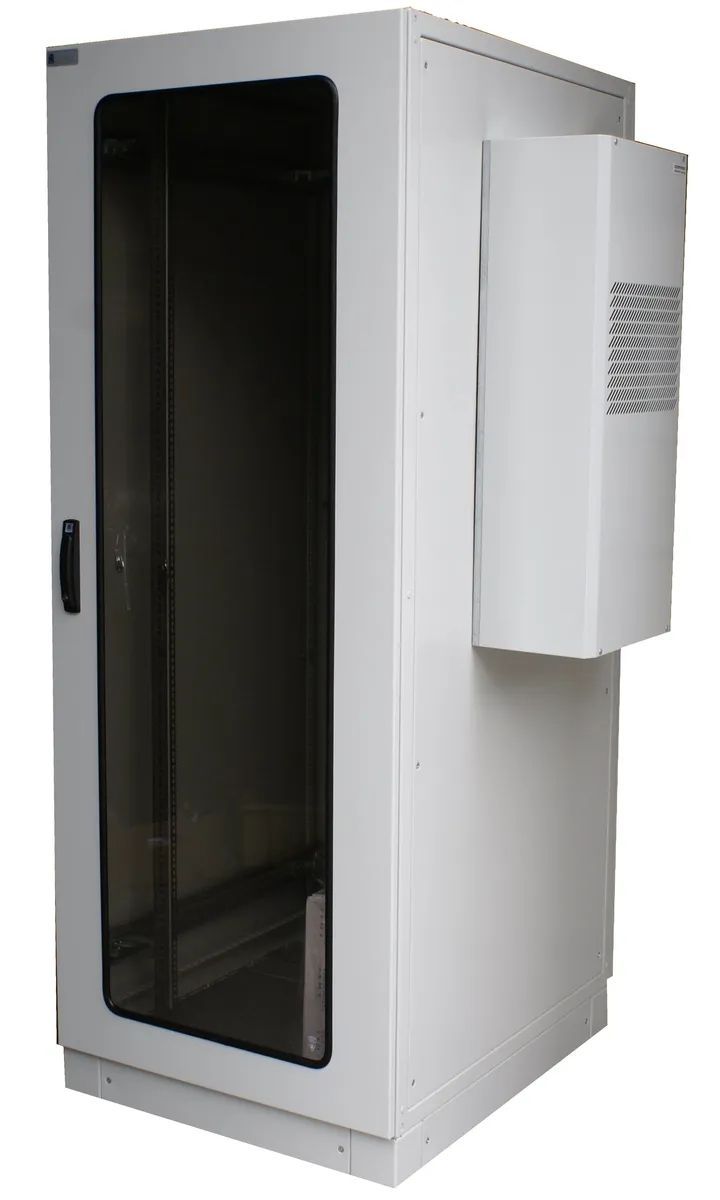
From passive to compressor: the three cooling stages
Server rack cooling grows with the heat load — from door perforation to a closed cooling circuit.
Perforated doors & air routing
In an air-conditioned server room, room cooling does the work: perforated doors (Z-SERVER: 86 % open area) let the cold air through the rack, while blanking panels and cold/hot aisle separation prevent short-circuit airflow.
up to ~2 kW per rack · IP 20 · server room View the Z-SERVER →Roof fans & fan units
If convection is not enough, roof fans provide a defined airflow: PWD-2W and PWD-4W (330/660 m³/h) or the quiet DL 1500 with 1,500 m³/h — thermostatically controlled and retrofittable.
330–1,500 m³/h · IP 20 · room air cooler than target Select in the configurator →CVE / ETE compressor cooling units
The server rack with a cooling unit: solid doors seal the rack (IP 54), and the CVE side-mounted unit or the ETE roof-mounted unit cools in a closed circuit — independently of the room temperature.
310–6,000 W cooling capacity · IP 54 · production & warm rooms View the cooling unit range →Filter fan, heat exchanger or cooling unit — the comparison
The right server rack climate control depends on two questions: Does it need to be colder in the rack than in the room? And may room air enter the rack? The answers decide the approach — from low-cost ventilation to an active cooling unit.
| Solution | Principle | Capacity / airflow | Prerequisite & typical use |
|---|---|---|---|
| Filter fan | Filtered room air flows through the rack — open air exchange with the room | 42–610 m³/h | Room cooler than the target internal temperature and the air clean — the lowest-cost, most energy-efficient solution. For server rooms and offices (IP 54). |
| Air/air heat exchanger | Closed internal circuit, heat dissipation via an exchanger profile — no room air in the rack | designed for each rack | Room cooler, but the air is laden with dust or moisture — keeps the rack closed and maintains the degree of protection. |
| Compressor cooling unit (CVE / ETE) | Active refrigeration unit, mounted on the side (CVE) or on the roof (ETE) — cools below the ambient temperature | 310–6,000 W | Room warmer than the target or high heat load — the only way if it has to be colder in the rack than outside. For production, warm equipment rooms and outdoor use. |
The cooling capacity calculator provides the required cooling capacity in accordance with IEC 60890; all units in detail on the page Cooling units & air conditioners.
How many kW of cooling capacity does my server rack need?
The short answer: it is not the size of the rack that decides, but the power loss of the installed equipment and the difference between the ambient and target internal temperatures. A typical network rack is 0.3–1 kW, a normally equipped server rack 2–6 kW, an AI/GPU rack considerably more. The following table is a guide for preselection — not a design: if the rack stands in a production area at 35 °C, the limits shift downwards; in a cool server room at 22 °C, they shift upwards.
| Heat load per rack | Obvious solution | ZPAS component | Condition |
|---|---|---|---|
| up to approx. 0.5 kW | Filter fan with outlet filter | LV + GV, 42–610 m³/h | Room air cooler than the target and clean enough for the filter |
| approx. 0.5–2 kW | Roof fan or air/air heat exchanger | PWD-2W / PWD-4W (330/660 m³/h), DL 1500 (1,500 m³/h) | Room still cooler; heat exchanger if the rack has to remain closed |
| approx. 0.9–3 kW | Air/water heat exchanger | CNW, 900–3,000 W | Chilled water network with sufficient flow rate available |
| approx. 0.3–6 kW | Compressor cooling unit, side-mounted or roof-mounted | CVE / ETE, 310–6,000 W | Rack sealed to at least IP 54; also works if the room is warmer than the target |
| above approx. 6 kW per rack | In-row cooling or precision air conditioning instead of a single-rack unit | BWC-DX2 (11.2 kW), KWT (12.3–37.7 kW), DX with external condenser (4.4–22.3 kW) | Cold/hot aisle separation or containment as a prerequisite |
Converting airflow (m³/h) into dissipated heat (kW) depends directly on the temperature difference between supply and exhaust air — which is why the fan rows above are deliberately given as a range. For the reliable figure: add up the power loss, enter the dimensions and temperatures, and let the calculator do the work.
ETE roof-mounted cooling unit: when there is no space at the side
The ETE roof-mounted cooling unit sits on the rack roof and cools in a closed internal circuit. It is the solution when the side surfaces are not available — for racks placed directly next to each other in a row, for racks against a wall or for narrow 600 mm server racks, where a side-mounted unit would unnecessarily widen the footprint.
Row installation & narrow racks
Racks stand side by side or against a wall, floor space is tight — the roof is the only free surface. Also useful where the side panels must remain removable.
Capacity class: 310–6,000 W (CVE/ETE range)Clearance above the rack
The unit adds height and releases the waste heat upwards or to the side. Sufficient room height, a free discharge area and access for maintenance are required — the critical point in rooms with a suspended ceiling.
Check height + discharge clearance + maintenance accessWaste heat stays in the room
A compressor cooling unit moves the heat from the rack into the installation room — plus its own electrical power. With several units in a small equipment room, the room itself needs ventilation or cooling.
Plan the condensate drainCVE side-mounted cooling unit: the standard approach for server racks
The CVE side-mounted cooling unit is fitted to the side of the rack or in the door and is the most common design when a server rack needs active cooling. The prerequisite is always a rack sealed to at least IP 54: solid doors, closed roof and floor plates, sealed cable entries. A perforated rack cannot be actively cooled in any meaningful way — the cold escapes and the unit runs permanently against the room.
- Capacity classes 310–6,000 W — from the small unit on a wall-mounted enclosure to the unit for a fully equipped 42 U rack.
- Side or door mounting — the footprint increases by the depth of the unit; this is usually not critical for free-standing racks, but in tight rows it is the reason to switch to the ETE.
- Air routing in the rack — cold air must reach the front of the equipment. Blanking panels in the free U and clean cable routing also help determine the result.
- Condensate — any condensate is drained away or evaporated; the drain belongs in the planning, not in the installation week.
- Limit at approx. 6 kW per rack — above that, the problem is not the unit but the waste heat in the room and the air routing in the rack. Then the way forward is in-row cooling.
CNW air/water heat exchanger: cooling without waste heat in the room
Where a chilled water network is available — in industrial plants, machine halls or data centres with central cooling generation — the CNW (900–3,000 W) air/water heat exchanger is the most efficient option. The rack remains closed, an internal circuit transfers the heat to a water heat exchanger, and the water carries it out of the room. Unlike with a compressor cooling unit, the waste heat therefore does not heat up the installation room.
Chilled water with defined values
Flow temperature, flow rate and pressure from the system design are required — without these details, a CNW cannot be designed. If there is no network, CVE/ETE is the way to go.
900–3,000 W per unitQuiet, low-maintenance, high density
No compressor on the rack: low noise, few moving parts, constant performance even at high room temperatures. Often the quietest solution for equipment rooms with several racks.
Degree of protection is maintained (closed circuit)Dew point and condensate
If the flow temperature is below the dew point of the room air, condensate forms — the drain or flow temperature control are part of the design. The same applies to shut-off and non-return valves for servicing.
Plan the condensate drain + shut-offSplit air conditioner: condenser outside the room
With a split design, only the cold part sits on or in the rack; the compressor and condenser are installed separately — in the neighbouring room, on the outside wall or on the roof. Both parts are connected by refrigerant lines. This is the right approach if the waste heat must not put an additional load on the installation room and there is no room air conditioning: for example in a small equipment room without windows, in a container or in rooms where a compressor on the rack would be too loud.
- When it makes sense: waste heat has to leave the room, chilled water is not available, the noise level in the room should remain low.
- Capacity classes: in data centre and container environments, ZPAS works with DX systems with external condensers from 4.4 to 22.3 kW — i.e. above what a single side-mounted unit can reasonably cover.
- What the split design involves: pipe routing, wall penetrations, a location for the outdoor unit and commissioning by a specialist refrigeration company. Legally, the requirements on fluorinated greenhouse gases must be met — the refrigerant circuit is not something that is closed on the side on the building site.
- Check the alternative: if a chilled water network is available, CNW is usually the simpler way to achieve the same goal — getting the heat out of the room.
In-row cooling: when the rack row is the unit
From about 6 kW per rack and with several racks in a row, the calculation tips: fitting a separate compressor cooling unit to each rack becomes costly, noisy and inefficient. Then it is no longer the individual rack that is cooled, but the rack row. The cooling unit stands between the racks, draws warm air from the hot aisle and blows cold air directly into the cold aisle — the air path becomes short, the temperature difference high and the cooling therefore efficient.
The prerequisite is always clean cold/hot aisle separation. Without containment, the airflows mix, and in-row cooling loses exactly the advantage it was built for. For this, ZPAS supplies the Databox containment with sliding doors, roof and lighting — and the matching cooling units:
BWC-DX2
11.2 kW cooling capacity, five EC fans, retrofittable without modifying the rack — for existing rack rows whose density has grown.
11.2 kW · standing in the rowKWT (chilled water)
12.3–37.7 kW via the chilled water network — for server rooms and data centres where central cooling generation is already in place.
12.3–37.7 kW · chilled waterDX with external condenser
4.4–22.3 kW, condenser outside the room — when there is no chilled water and the waste heat still has to go outside.
4.4–22.3 kW · condenser outsideFor AI and GPU racks, the density is considerably higher again; the guide AI/GPU server rack describes the consequences for load capacity, perforation and cooling concept. The related system page: Data centre & server room.
Network cabinet with cooling — when is a cooling unit necessary?
Thermally, a network cabinet is a different case from a server rack. Wall-mounted enclosures (6–21 U), office and shallow floor-standing cabinets are typically no more than 800 mm deep and house patch panels, one or two switches and often a small router or a small UPS. The heat load is therefore usually between 0.2 and 1 kW — an order of magnitude that can be dissipated in a room at normal temperature by convection, a roof fan or a filter fan. A compressor cooling unit is generally oversized here.
A filter fan or roof fan is sufficient
If the cabinet stands in an office, an equipment room or a heated distribution room and the surroundings are cooler than the permissible internal temperature, LV filter fans with GV outlet filters or a roof fan are sufficient. With glass doors, the heat still has to get out somewhere — plan ventilation slots or fans.
0.2–1 kW · LV/GV 42–610 m³/h · IP 20–54When a cooling unit becomes necessary
Three triggers: the surroundings are warmer than the target (production, ceiling void, uncooled equipment room), the cabinet must remain closed (dust, moisture, swarf), or the load rises above approx. 1 kW in a closed wall-mounted enclosure. Then the way forward is a heat exchanger or — from IP 54 — a CVE cooling unit.
sealed from IP 54 · CVE from 310 WA wall-mounted enclosure has little surface area
With a wall-mounted enclosure, neither the roof nor the side can be used as freely as with a floor-standing cabinet. If the passive solution is no longer sufficient, switching to a floor-standing cabinet with enough surface for fans or a cooling unit is often more sensible than retrofitting the wall-mounted enclosure.
Z-BOX / Z-CUBE 6–21 U · floor-standing cabinet up to 45 UThe page 19-inch network cabinet explains which network cabinet suits the task — wall-mounted enclosure, office cabinet or floor-standing cabinet. You can check the heat load in advance in the cooling capacity calculator.
Air-conditioned server racks ex works
ZPAS supplies rack and climate control as one unit: cooling designed, cut-outs made, units mounted and wired — ready for operation ex works.
Z-SERVER
Heavy-duty server rack, 42–47 U, 1,600 kg static on levelling feet, 2,000 kg without. Perforated for cold/hot aisles — or closed with IP 54 and a CVE/ETE cooling unit for sites without room cooling.
To the series →SZB IT
The universal 19″ rack (18–47 U) for network and server equipment: with glass, perforated or solid doors, preparation for roof fans and accessories from stock.
To the series →SZE2 PC
The PC cabinet in IP 54 for areas with dust and splashing water: sealed enough for a compressor cooling unit, three lockable compartments for monitor, keyboard and computer.
To the series →Outdoor server rack: 19″ equipment outdoors
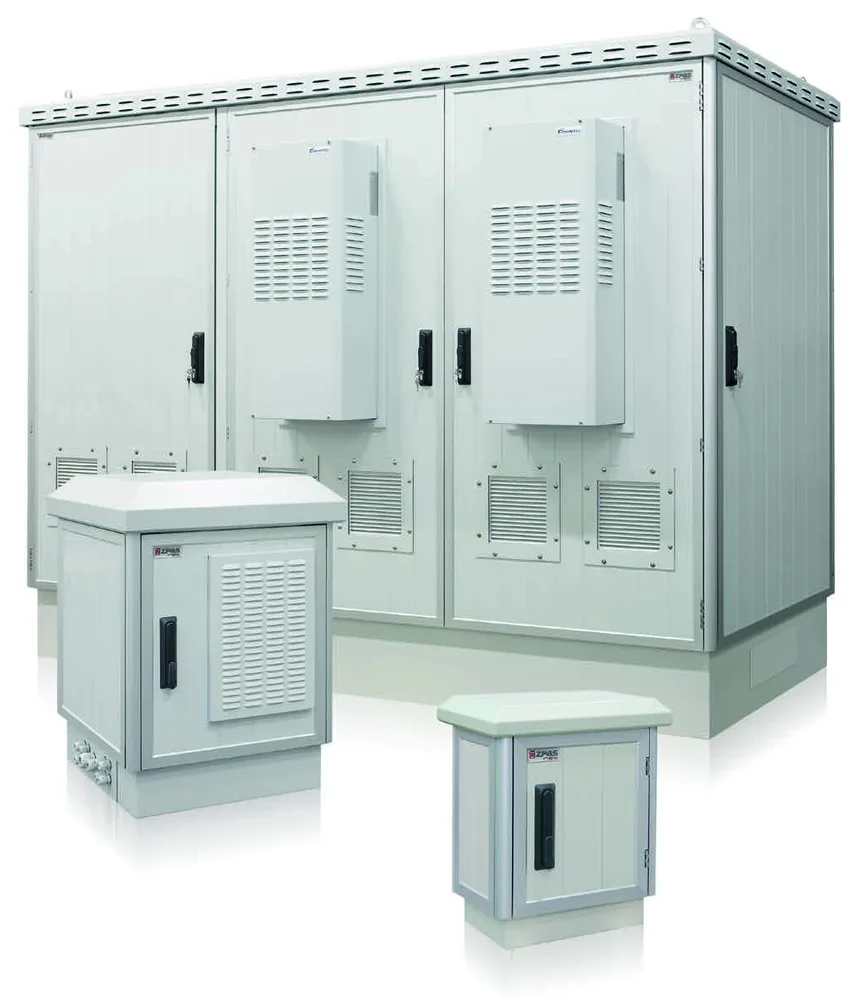
If the active equipment stands outdoors — at a mobile phone mast, in a solar park, along the line — the outdoor server rack based on the double-walled aluminium SZD series takes over: the rear-ventilated double wall passively keeps out solar heat, the 19″ level carries the rack equipment, and the climate control is designed for the site. The page Outdoor enclosure cooling describes the outdoor design options in detail — from forced ventilation to the AHP heat pump.
- Operating range −40 to +70 °C, degree of protection IP 54/55, IK10
- Air/air heat exchanger, CVO outdoor air conditioner or AHP heat pump
- Heating against frost and condensation, filter fans for temperate sites
- Any special size — direct from the factory
Enquire about climate control
Briefly describe the site and the equipment — we will design the rack and cooling and get back to you with a quotation within 2 working days at most. The values from the cooling capacity calculator make it even more precise.
Frequently asked questions — server rack climate control
When is passive ventilation enough in a server rack?
As long as the room is cooler than the permissible internal temperature and the heat load remains moderate: perforated doors (Z-SERVER: 86 % open area) plus clean cold/warm air routing are then sufficient. If the power loss or the room temperature rises, roof fans follow and, from the IP 54 version upwards, active cooling units.
How do I calculate the cooling capacity for a server rack?
From the power loss, the rack dimensions and the ambient and target internal temperatures. The free cooling capacity calculator determines the guide value in accordance with IEC 60890 in seconds — including a recommendation as to whether a fan, heat exchanger or cooling unit is the right choice.
Which cooling units fit the Z-SERVER?
In the closed IP 54 version: CVE side-mounted cooling units (310–6,000 W) or ETE roof-mounted cooling units. In the ventilated version (IP 20), the PWD-2W/PWD-4W roof fans (330/660 m³/h) or the DL 1500 provide the airflow — all selectable in the server rack configurator.
Are there air-conditioned server racks for outdoor use?
Yes — the outdoor server rack based on the double-walled SZD series: 19″ level, −40 to +70 °C, with heat exchanger, CVO outdoor air conditioner or AHP heat pump. Details in the thermal management section.
How many kW of cooling capacity does my server rack need?
This is determined by the power loss of the installed equipment, not by the size of the rack. A network rack is typically 0.3–1 kW, an equipped server rack 2–6 kW. As a rough preselection: up to approx. 0.5 kW filter fans (LV/GV, 42–610 m³/h), 0.5–2 kW roof fans or air/air heat exchangers, 0.9–3 kW the CNW air/water heat exchanger, 0.3–6 kW a CVE/ETE compressor cooling unit, above that in-row cooling. The cooling capacity calculator in accordance with IEC 60890 provides the reliable figure — see the section kW classes.
What is the difference between a heat exchanger and a cooling unit?
A heat exchanger only moves heat — it can never make the rack colder than the surroundings (air/air) or than the cooling water (air/water, CNW, 900–3,000 W). A compressor cooling unit (CVE/ETE, 310–6,000 W) actively produces cold and keeps the internal temperature independent of the surroundings. Rule of thumb: surroundings cooler than the target → a heat exchanger is sufficient and more economical. Surroundings equally warm or warmer → only a cooling unit can do the job, and for this the rack must be sealed to at least IP 54.
When do I need a roof-mounted cooling unit?
Whenever the side surfaces are not free: racks stand directly next to each other in a row, the rack stands against a wall, or the footprint must not become wider. The ETE uses the rack roof instead. Room height, a free discharge area above the rack, maintenance access and the condensate drain must be checked. If the side is free, the CVE side-mounted unit is usually the simpler option — details in the section ETE roof-mounted cooling unit.
What cooling does a network cabinet need?
Usually no active cooling at all: network cabinets — wall-mounted enclosures of 6–21 U, office or shallow floor-standing cabinets up to 800 mm deep — typically have a heat load of 0.2–1 kW. In a room at normal temperature, convection, a roof fan or an LV filter fan with GV outlet filter is sufficient. A cooling unit only becomes necessary if the surroundings are warmer than the permissible internal temperature, the cabinet has to remain closed because of dust or moisture, or the load in the closed wall-mounted enclosure rises above approx. 1 kW.
Climate control direct from the manufacturer
Server rack and cooling from a single source — calculated, designed and delivered mounted ex works.