
Racks for AI
& GPU infrastructure
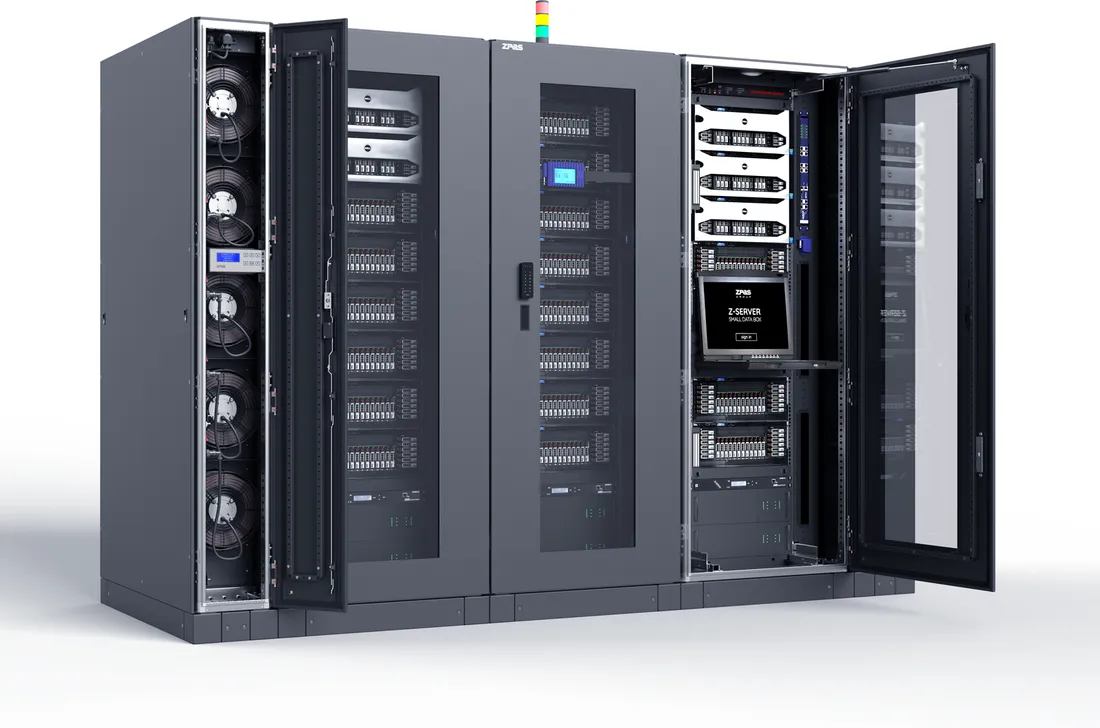
GPU nodes weigh 30–90 kg per rack unit and generate 30+ kW of heat per rack — the limits of conventional server racks. ZPAS builds the high-load foundation for AI clusters: Z-SERVER up to 2,000 kg static (without levelling feet), 86 % perforation, cold-aisle ready, with PDUs, cable management and monitoring fitted at the factory.
Request a quote Configure a rackAI infrastructure starts with the rack
Much is written about GPUs, network topologies and cooling concepts — and then installation fails on a question nobody asked: Can the rack actually carry it? A fully loaded GPU rack today weighs more than a tonne, draws double-digit kilowatts and needs airflow without any recirculation. ZPAS supplies the mechanical foundation: the Z-SERVER with up to 2,000 kg static load capacity (without levelling feet), reinforced 19″ levels and 86 % door perforation — individually or as a contained row.
The technical design step by step — weight, power, cooling, fire protection — is explained in the AI & GPU server rack guide.
Typical projects in AI infrastructure
GPU clusters & training pods
High-load racks in rows with cold aisle containment — designed for weight, airflow and high-current PDUs.
Inference & edge AI
Individual racks or Data Box systems in the server room — and outdoor versions for AI nodes outside the building.
High heat loads
Air cooling up to ~30 kW per rack with strict separation — mechanical preparation for close-coupled cooling and liquid cooling.
Power & PDUs
Several high-current PDUs per rack, separate feeds, cable management for large conductor cross-sections.
Monitoring right into the rack
AKCP sensors for temperature, power and access — an alarm before the cluster throttles.
Custom fit-outs
Reinforced floors, special depths, feed-throughs for coolant lines — straight from our own production.
Requirements for the AI rack — clearly classified
Load capacity 1,600–2,000 kg
GPU nodes weigh 30–90 kg per U. The Z-SERVER carries 1,600 kg static on levelling feet, 2,000 kg directly on the floor. On the castor set it is 1,500 kg — there the castors are the limit, not the rack.
Depth 1,000–1,200 mm
Current GPU systems are long; on top come PDUs, cables and air space. Z-SERVER: 600/800 mm wide, 1,000/1,200 mm deep.
Airflow without recirculation
86 % perforation, blanking panels, brush strips and containment — at 30+ kW every leak matters.
Scaling to a row
Bayable, containable, upgradable — from pilot rack to pod without changing system.
Standards for AI racks
For AI areas too, the DIN EN 50600 series of standards remains the planning framework for the data centre — availability, cooling concept and physical security are defined there, and the rack has to deliver what the concept requires. The 19-inch level follows IEC 60297 (482.6 mm standard), manufacturing is to ISO 9001/14001; ZPAS provides product-specific documentation for each order.
The practical difference from a conventional server rack comes down to three figures: load capacity (GPU racks reach 1,000–1,500 kg), airflow (86 % door perforation instead of standard perforation) and depth (1,200 mm for current GPU chassis including cable space). The AI rack guide shows in detail what planning for 30–100 kW per rack looks like.
Which rack for which task in the AI cluster?
The overview matches the series to the tasks — details on the series pages:
| Series | Rack units | Load capacity | Special feature | Typical application |
|---|---|---|---|---|
| Z-SERVER | 42/45/47 U | 1,600 kg on levelling feet, 2,000 kg without levelling feet | 86 % door perforation, 1,200 mm deep | GPU & training racks |
| SZB IT | 18–47 U | up to 1,500 kg | 600/800 mm wide, door opens up to 270° | Storage, network, management |
| SZB IT-MAX | 42–52 U | up to 1,500 kg | up to 1,000 mm wide, space for PDUs and cables | Densely populated GPU and network racks |
| SRD / SRX | 24/36/42 U | 150 / 250 kg | open 19″ racks | Patch panels & distribution |
| Outdoor server rack | project-specific | project-specific | double-walled, IP 54/55, climate-controlled | Edge inference outside the data centre |
The racks are only the visible part: only the interplay of containment, cooling and monitoring turns a row of racks into an AI area that keeps its heat load under control for the long term. That is why ZPAS plans the row as a system — from the blanking panel range to the sensors in each zone.
Typical project: GPU cluster at a mid-sized company
Starting point: a company is setting up its own training cluster with six GPU racks — in a server room that was never planned for it. The critical questions: can the raised floor carry the point load? Where does enough cold air come from? And how do the loaded racks get into the room?
The solution: Z-SERVER 47 U placed directly on the floor without levelling feet (2,000 kg static), as a row with cold aisle containment against bypass air, with blanking panels and brush strips fitted at the factory. Redundant PDUs per rack, AKCP monitoring of temperature and power in each rack. The load distribution on the raised floor is clarified before delivery, and the racks arrive pre-assembled — the GPU systems roll straight in. After roll-out, the monitoring provides the data for fine-tuning cooling and utilisation; the next expansion stage starts as a repeat order to the same drawing.
Planning checklist: AI & GPU racks
These points should be clarified before ordering:
- Load capacity & floor: rack weight when fully loaded plus a reserve — and the point load rating of the raised floor at the installation site.
- Cooling concept: air cooling with cold aisle, rear door or in-row — the heat load per rack decides, not the average.
- Dimensions: 1,200 mm depth for GPU chassis, 800 mm width if power and data cables are to be routed separately.
- Power: redundant feed (A/B) and PDU fit-out per rack — fitting at the factory saves time during roll-out.
- Monitoring: temperature per zone, power consumption per rack, door contact — define alarm paths before commissioning.
- Expansion: plan the row and containment so that further racks can be added without conversion work.
Why ZPAS for AI projects
Short paths instead of corporate processes: at ZPAS, special requirements — reinforced levels, coolant feed-throughs, special depths — go straight into production, with lead times that fit project schedules. And the racks arrive ready to equip: PDUs fitted, cable routes prepared, cooling designed, monitoring integrated.
Frequently asked questions — AI & GPU racks
How heavy can a GPU rack get?
Fully loaded, 1,000–1,500 kg today. The Z-SERVER carries 1,600 kg static on levelling feet, 2,000 kg without levelling feet.
Is air cooling still enough for AI servers?
Up to ~30–35 kW per rack with strict cold/hot aisle separation. Beyond that: close-coupled cooling or liquid cooling — ZPAS prepares the rack mechanically for it.
What rack depth do GPU servers need?
1,000–1,200 mm is standard — the Z-SERVER is available in both depths.
What distinguishes an AI rack from a standard server rack?
Load capacity, power distribution and airflow — the guide explains the design in detail.
Which standards govern the planning and manufacture of AI racks?
Data centre planning follows the DIN EN 50600 series of standards, the 19-inch level follows IEC 60297; manufacturing is to ISO 9001/14001 with CE marking. ZPAS supplies product-specific documentation for each order.
How is a GPU rack supplied with power?
Via redundant PDUs with separate A/B feeds, fitted and documented at the factory. The design (phases, fusing, connector systems) is agreed with the electrical planners for each project.
Can AI hardware also be installed outside the data centre?
Yes — for edge inference there is the outdoor server cabinet on a double-walled SZD base (−40 to +70 °C) and, for larger units, the container data centre as a system ready for fit-out.
Planning an AI cluster?
The number of racks, weights and heat load are all we need — we reply with a design and a quotation within 2 working days at most.